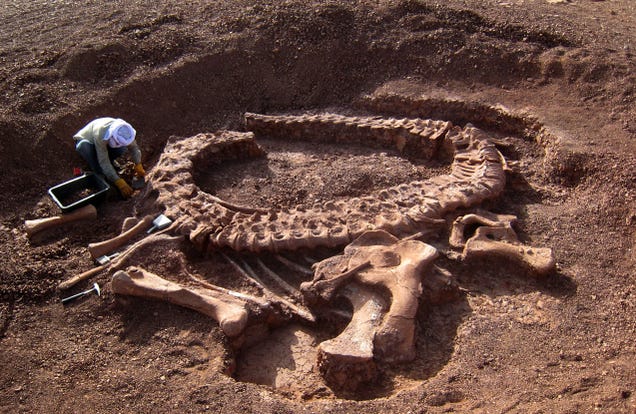
Want to Join a Dinosaur Dig this Summer? You Can!
Just because you're not a professional paleontologist doesn't mean you can't help professional
paleontologists on a real dinosaur dig. In recent years, a number of
programs have started allowing allow non-paleontologists to assist in
professional fossil excavations, usually for a fee. If you hadn't come
up with a summer vacation idea yet, one of these might be for you.
The work is very
hard, and dirty, and usually very hot too. But you get to help unearth
scientifically valuable fossils, helping out scientists, museums and/or
universities in the process. And with all that physical labor under the
hot summer sun, you might be in better shape afterward, too.*
What
follows is a list of public digs in the US and Canada, by
province/state. I have also tried to only include programs where the
fossils you uncover remain in the public trust, i.e. are given to
museums, universities, etc.
Alberta, Canada
Dinosaur Provincial Park
offers 1, 2, and 3 day dinosaur digs for participants ages 14 and up.
Includes lodging (for multi-day digs). Cost depends on package, from
$165-700.
Colorado, USA
The
Museum of Western Colorado
offers one-day digs at the Mygatt-Moore quarry, where for $135 per
person, you assist in removing dinosaur bones and teeth from the
"Jurassic Gladiator Pit". Includes lunch.
Florida, USA
If
you want dinosaurs in Florida, you're probably out of luck. But you
can still hunt for Cenozoic mammal fossils with the Florida Museum of
Natural History. 2014 digs were over in April, but you could probably
get an early start on signing up for the
2015 dig season.
Manitoba, Canada
The
Canadian Fossil Discovery Center
offers everything from 1/2 day to 5 day excavations, ranging in price
from $50 - $525. As this area was under the Western Interior Seaway
during the Late Cretaceous, you're not excavating dinosaurs, but rather
mosasaurs and other marine fossils.
Montana, USA
The Great Plains Dinosaur Museum has two options: for kids aged 5-13, the
Junior Paleo Field Experience
gives them 3 hours in the field at a dinosaur dig site ($100 covers the
child and their accompanying adult). For anyone aged 11 or older, the
Adult Field Program
lets you spend days in the field, with the 2014 expeditions returning
to some unusual fossil material turned up last year. $200/day, or
$170/day if you stay 3 days or more.
The
Judith River Dinosaur Institute
is likely full for 2014 (they were 95% full by April 1), but you can
still sign up for a July or August 2015 spot. $1,695 for a week
excavating in Montana, which includes food and gear but you bring your
own tents and share the cost of transportation. This year's dig teams
will be digging up stegosaurs and a (possibly new species of) mid-sized
sauropod.
PaleoTrek works in Montana in cooperation with two Missouri science organizations. This year's teams will be finishing excavation of a
Triceratops
skull, prospecting, and working another known bonebed. $50 per day (2
day minimum) gets you transportation and food, but you're on your own
for lodging.
The similarly-named
PaleoWorld Research Foundation
has ongoing digs all of June and July, 7 days a week, 8:30-4. $160/day
($80/day for those under 15). Lodging/meals available, but extra.
New Mexico, USA
Mesalands Community College
offers summer field courses worth 4 college credits! $650 buys you a
week of in the field, prospecting, documenting, and excavating 200
million year old Late Triassic fossils. Lab work is done in the hot
afternoons, and the course wraps up with a barbecue at the end of the
week.
North Dakota, USA
The
Marmath Research Society
operates in the Hell Creek formation of North Dakota (and a little bit
into Montana). In 2014 they are digging for 5 weeks . . .
minimum participation
is 1 week at $1000 per person. Your second week is $900, each
additional week is another $850, with discounts for high school teachers
and students. Fee includes meals, lodging, transportation, tools, and a
The
North Dakota Geological Survey
has five public digs scheduled this year, ranging from mammal fossils
to marine reptiles to dinosaurs to crocodiles. Excursions range in cost
from
free (mammals, public responsible for own
transportation, lodging and food on daily excursions) to $1000 for the
week-long dinosaur dig.
Texas, USA
The
Arlington Archosaur Site is a rich fossil bed containing an entire
coastal plain ecosystem: numerous dinosaurs, nesting crocodiles,
turtles, and fish. Expeditions are open to any and all volunteers, but
the schedule appears somewhat informal.
Join their Facebook group to contact them about upcoming digs.
Wyoming, USA
Casper College
is collecting a sauropod in June and a hadrosaur in September, both for
their geological museum collection. $800 per person for six days,
includes all lodging and transportation and most food.
GeoWorld Travel is offering a 10-day intensive dig for the very American price of £
1995, from
18 to 27 August 2014
. Includes all food, equipment and training, but you bring your own tent.
The
Wyoming Dinosaur Center's
"Dig-for-a-Day" program, from late spring to early fall, lets you spend
a full day (8:30 - 5) traveling to and working in the field (usually on
sauropod bones). $150 per adult and $80 per child.
*Field
paleontology is not approved by the FDA for use in weight loss, and has
not been demonstrated to be an effective weight loss program.
Dig here