Thursday, October 30, 2014

An Illustrated History of Dinosaur Parks

The world's first dinosaur park, Crystal Palace Dinosaurs in London, did not have a Tyrannosaurus rex. A glaring omission, you might think, but an understandable one: the park opened in 1854, over 50 years before the T. rex species was named.

Dinosaur parks, whether Victorian fields of stone sculptures or Jurassic Park-influenced, animatronically enhanced attractions, reflect not only the technology of their time, but the paleontological knowledge. As more fossils are discovered, and more revisions to classification and rendering made, these parks become time capsules populated by creatures that are often, in retrospect, kinda goofy looking.

In 1842, English paleontologist Richard Owen analyzed the fossils of three Mesozoic-era reptile genera—Megalosaurus, Iguanodon, and Hylaeosaurus—and found enough similarities to establish a new taxonomic group. He named this group dinosauria, from the Greek deinos ("terrible") and sauros ("lizard").

It was Owen who spearheaded the development of Crystal Palace Dinosaurs, a collection of life-sized models that would constitute the first publicly accessible prehistoric theme park. To realize this vision, Owen teamed up with sculptor and natural history artist Benjamin Waterhouse-Hawkins, who was fresh from overseeing London's Great Exhibition of 1851.

Waterhouse-Hawkins spent three years sculpting over 30 dinosaurs and other prehistoric creatures under Owen's guidance. After the animals were completed, Waterhouse-Hawkins celebrated with a banquet on the last day of 1853, held, in the words of Edward MacDermott's 1854 guide to Crystal Palace, "within the carcass of one of his antediluvian monsters." Twenty-one guests were seated to dinner inside a mold that had been used to cast one of the park's iguanodons. (MacDermott noted that "When the more substantial viands were disposed of, Professor Owen proposed that the company should drink in silence [to] 'The memory of Mantell, the discover of the iguanodon,' the monster in whose bowels they had just dined.")

Though public enthusiasm for the park was high—"terrible lizards" being an exciting and mysterious new thing for Victorians—Crystal Palace struggled financially. Sculpting each model was an expensive undertaking, and funding ran out before Waterhouse-Hawkins could create his full planned roster of stone animals. As palentological discoveries in the late 19th century caused revisions in the rendering of dinosaurs—influenced by the evolutionary theories evinced in Charles Darwin's On the Origin of the Species, published in 1859—Crystal Palace's creatures became less and less accurate. By the dawn of the 20th century, the park had become run-down and risible.

Full article and more pix here

Wednesday, October 29, 2014

‘Zaraapelta’ looked like a colourful hedgehog


An old dinosaur has been given a new name.
A new species of ankylosaur (ANK’-EYE’-lo-saur) was discovered in Mongolia in 2000 by a team led by University of Alberta researchers.
A zoological journal published a paper this week by the same group naming the creature Zaraapelta (zar-ah-PELL’-tah) nomadis.
Zaraapelta is a combination of Mongolian and Greek works meaning “hedgehog” and “shield.”
Like other ankylosaurs, Zaraapelta was an armoured plant-eater with a gigantic club for a tail.
But it was more spectacular than most, with distinctive horns and an elaborate pattern of bumps and grooves behind its eyes.
Its skull is part of a collection at the Mongolian Paleontologist Center.
Link

Sunday, October 26, 2014

Ancient Stone-Cutting Techniques Preserve Dinosaur Tracks


Unearthing the fossilized bones of dinosaurs without destroying them is already a pretty fiddly process, one that requires time, patience, and many, many delicate brushes. But when you're talking not about bones but the even more delicate tracks that dinosaurs left behind, the process gets that much trickier.
In response to reading about some ancient marble-cutting techniques, commenter and ichnologist Phaton explained that there were some remarkable similarities between the techniques of old stone-cutters and modern methods of dino-track salvage:
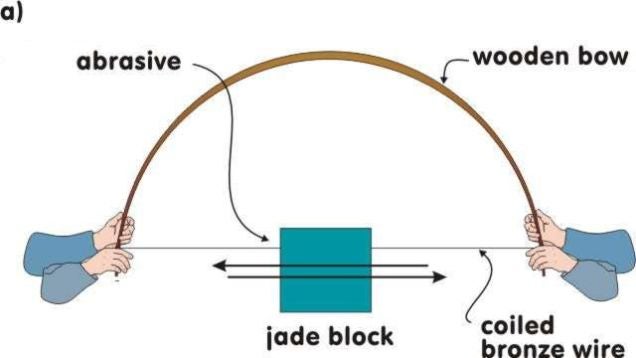
I had to figure out a way to remove a bunch of rock from a specimen with out damaging the fossil footprint. We were in the process of moving to a new building with a weight restriction on the floor and the block was going to probably be too heavy. The footprint, while large (tyranosaurid), was quite fragile so power tools were out of the question. In trying to figure something out I looked into a lot of ancient techniques. What I ended up using was a modification on a Chinese bow saw but instead of coiling bronze wire between the bow I coiled it around an iron shaft so that it was a one man operation... I don't remember why but I think I called it a Phoenician saw for some reason (a google search turns up nothing useful).

Anyways to make a long story shortish: the key to ancient rock cutting it time. As long as you have an abrasive harder then what you are cutting you are going to succeed eventually. Though I didn't actually succeed myself because before I could really start cutting we found really small turtle tracks associated with the theropod track and ended up needing to keep the whole block(it was one of those things where the theropod track was so imposing that you just didn't notice the smaller prints... but once you saw one...).

Article link here

Friday, October 24, 2014

Man who stole 190-million-year-old dinosaur footprint gets house arrest

"I'm just extremely sorry for a horrible decision that I made."

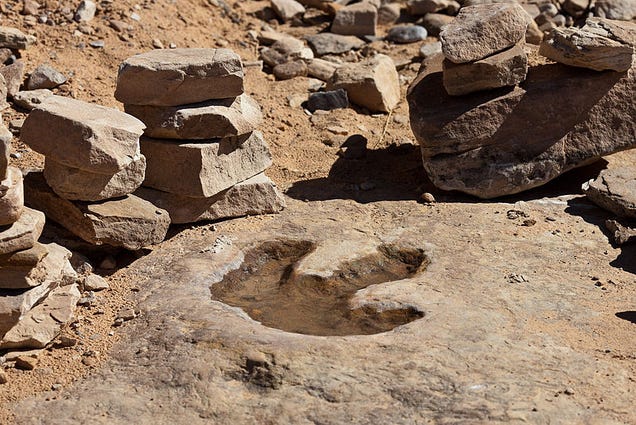
A Utah man was sentenced to a year probation, half of which must be served under house arrest, and fined $15,000 Monday after pleading guilty to stealing a fossilized dinosaur footprint believed to be 190 million years old.
The defendant, Jared Ehlers, 35, said he was "sorry" for unhinging the 150-pound sandstone slab in the Sand Flats Recreation Area of Southeastern Utah and dumping the three-toed print into the Colorado River. "I don't have a lot to say," Ehlers said during sentencing before US District Judge Dale Kimball. "I'm just extremely sorry for a horrible decision that I made."
While on the Hell's Revenge trail, Ehlers saw that the footprint was loose. He pried it up and took it to his nearby Moab home. Federal authorities said he dumped the print after being questioned about the print. He pleaded guilty in July to a felony count of theft of a paleontological resource.

Link to full article

Wednesday, October 22, 2014

Bizarre dinosaur reconstructed after 50 years of wild speculation

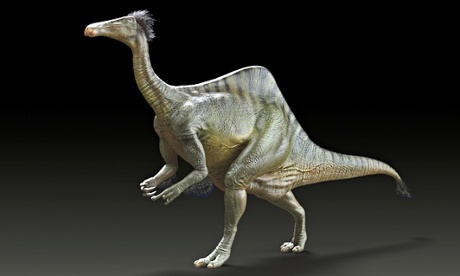
Deinocheirus mirificus, or ‘unusual horrible hand’, had long, clawed forearms, a sail on its back and a duck-like bill
Nearly 50 years after researchers uncovered the gigantic arms of a mysterious dinosaur in the Gobi desert, the true nature of the beast has finally been established.
Since its discovery in 1965, the only clues to the engimatic creature were its shoulders and forelimbs – the latter measuring an astounding 2.4 metres long – and a few ribs and vertebrae dug from the ground by a joint Polish-Mongolian expedition.
The fossils were extraordinary enough for scientists to declare the dinosaur a new genus and species. The name they decided upon was Deinocheirus mirificus, meaning “unusual horrible hand”.
In the absence of more complete remains, early reconstructions were at times wildly speculative. In 1970, one palaeontologist argued that Deinocheirus was a giant sloth-like climber that hung beneath the branches of enormous trees. A more accurate view put the dinosaur in a group of beaked omnivores called ornithomimosaurs, which resembled giant ostriches, at least superficially.
But writing in the journal Nature on Wednesday , a Korean-led team of experts has transformed scientists’ understanding of the animal. They report the discovery of two nearly complete 70 million-year-old Deinocheirus skeletons, pieced together from fossils unearthed in Mongolia, along with a skull and hand that had been poached and sold on to private collectors.
With the new remains, the researchers built the first accurate reconstruction of the dinosaur. The creature stood tall on its back legs, but sported long, clawed forearms. Neural spines formed an impressive sail on its back and its long, toothless snout flared out to both sides. The duck-like bill may have helped Deinocheirus forage for food at the bottom of streams, while blunt, flattened bones under its claws prevented it from sinking on wet ground.
One of the new specimens grew to 11 metres long and weighed more than six tonnes. Its broad hips and large feet suggest it was not agile. The animal likely fed on plants and small animals, though the remains of fish were found among its stomach contents.
Read more here