Showing posts with label fossil. Show all posts

Friday, July 24, 2015

Shorter limbs than T-rex

Four-legged snake fossil stuns scientists—and ignites controversy

Scientists have described what they say is the first known fossil of a four-legged snake. The limbs of the 120-or-so-million-year-old, 20-centimeter-long creature are remarkably well preserved and end with five slender digits that appear to have been functional. Thought to have come from Brazil, the fossil would be one of the earliest snakes found, suggesting that the group evolved from terrestrial precursors in Gondwana, the southern remnant of the supercontinent Pangaea. But although the creature’s overall body plan—and indeed, many of its individual anatomical features—is snakelike, some researchers aren’t so sure that it is a part of the snake family tree.

The team’s scientific interpretation may be the least controversial aspect of the discovery, which they report online today in Science. The specimen’s provenance seems to be murkier than the silty waters that once buried its carcass. Whereas the team’s analyses strongly suggest the fossil came from northeastern Brazil, details of when it was unearthed and how it eventually ended up in the German museum where it now resides remain a mystery. Those details matter to many researchers and especially to some from Brazil, because it’s been illegal to export fossils from that nation since 1942.

Aptly, the new species has been dubbed Tetrapodophis amplectus. The genus name, in Greek, means “four-footed serpent.” (Previously, fossils of creatures considered to be protosnakes have only sported one set of limbs, usually hindlimbs.) The species name amplectus, which comes from Latin, means “embracing” and refers to the creature’s flexibility and presumed ability to wrap tightly around its prey. The front part of the fossil—which appears to be complete and has all bones in their original, lifelike arrangement—lies in a tight coil, a demonstration of the animal’s extreme limberness, says Nicholas Longrich, a vertebrate paleontologist at the University of Bath in the United Kingdom and co-author of the new study. Besides the tiny limbs, the specimen sports a skull the size of a human fingernail, 160 spinal vertebrae, and 112 vertebrae in the tail.

The fossil had resided in a private collection for several decades before it gained the attention of team member David Martill of the University of Portsmouth. He stumbled across the specimen during a field trip with students to Museum Solnhofen in Germany. No notes about when or where it was collected are available, the researchers say. But certain characteristics of the limestone that entombed the fossil, as well as the distinct orange-brown color of the bones themselves, strongly suggest it came from a particular area of northeastern Brazil, Longrich says. The sediment that became those rocks accumulated in calm waters on the floor of a lake or a lagoon sometime between 113 million and 126 million years ago, he notes.

Regarding the legality of the fossil’s collection or export from its presumed home country, Martill says “Who knows how the fossil came from Brazil”? Furthermore, he notes, to assert that the fossil was collected illegally a person would need to ascertain when it was unearthed. But such questions are irrelevant to the fossil’s scientific significance, Martill maintains. “Personally I don’t care a damn how the fossil came from Brazil or when,” he says.

Many features of Tetrapodophis point to its snakiness. Among squamates, the group of reptiles that also includes lizards, only snakes have more than 150 spinal vertebrae, the researchers note. The creature’s teeth are pointy and slightly curved. Also, the fossil includes some scales that stretch across the full width of the belly, a trait known only in snakes. The dramatically reduced size of the creature’s limbs, as well as a cylindrical rather than a flattened tail, suggest that snakes evolved from terrestrial animals that burrowed, not from marine creatures as some researchers have proposed, Longrich says.

Read more here

Wednesday, June 3, 2015

This aught to ruffle a few feathers


Most dinosaurs had scales, not feathers, fossil analysis concludes 

Researchers have called time on a growing suspicion that many dinosaurs were not the dry, scaly animals of popular conception, but fluffy, feathered beasts instead.

Remains unearthed in recent years have revealed feathers or proto-feathers on a range of dinosaurs, leading some paleontologists to wonder if all of the animals evolved from a feathered ancestor and sported some kind of plumage themselves.

But while many meat-eating theropods, such as velociraptors and relatives of tyrannosaurs, were clearly clad in feathers, a fresh analysis of prehistoric remains suggests that most dinosaurs were scaly beasts after all.

Nicolás Campione, a dinosaur researcher at Uppsala University in Sweden, worked with scientists at the Natural History Museum in London and the Royal Ontario Museum in Toronto to survey some of the best-preserved dinosaur fossils from museums around the world.

The scientists collected information on around 75 species that are known from the fossil remains of their soft tissues to have had either scales or feathers. From these, they created a dinosaur family tree and used a statistical model to work out the odds of species having feathers at different points in dinosaur history.

“What we found from this analysis is that the first dinosaur was probably not feathered,” said Campione. “Feathers clearly evolved in the dinosaur lineage, but right now, the data do not point to a feathered ancestor for them all.”

The first dinosaurs evolved from reptiles more than 230 million years ago. Feathers are thought to have arisen more than once in dinosaur lineages, and while they live on and give flight to modern birds, feathers first emerged for other reasons: for warmth or to provide colourful plumage displays.

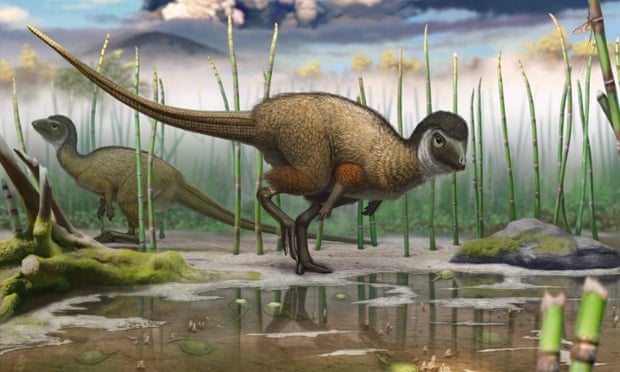
Last year, scientists announced the discovery in Siberia of Kulindadromeus, a small, 150 million-year-old, plant-eating dinosaur that had both scales and feathers. The finding of such an ancient plumage prompted the group to speculate that a fuzzy coating of feathers may have been the rule for dinosaurs rather than the exception. Some artists have run with the idea and drawn up depictions of giant feathered brontosaurs.

Wednesday, February 25, 2015

Private ownership of fossils? Yay or nay?

Dinosaurs for sale: How fossil business impacts science

Commercial sellers offer scientists access to unique specimens, but at a cost

In 2009, commercial fossil hunters in Montana excavated what was, unbeknownst to them, the jaws of an important new species of dinosaur.

Scientists weren't informed, and the fossil was sold to a private collector.

Fortunately, the story doesn't end there, as it sometimes does.

'It's wrong for people to assume they can get something for free.'- Peter Larson, Black Hills Institute of Geological Research

In the fall of 2010, the private collector heard that paleontologist David Evans of the Royal Ontario Museum in Toronto would be visiting his town of Fort Peck, Mont. He wanted to know more about the fossil he had purchased, so he showed it to Evans.

"I was blown away," Evans recalled. "I instantly knew it was a new species of raptor."

"It was a unique find that is scientifically very important," added Evans, who co-authored a paper describing the new raptor in 2013.

The jaws turned out to belong to the only raptor from its time period ever found in North America. The turkey-sized meat-eater named Acheroraptor temertyorum would help paint a more vivid picture of the diverse ecosystem where Tyrannosaurus rex stalked Triceratops 66 million years ago.

Acheroraptor also revealed a surprise — it was a close relative of dinosaurs in Asia, suggesting that dinosaurs were migrating between continents.

But no one knew any of that until Evans, the  ROM's curator of vertebrate paleontology and an associate professor at the University of Toronto, talked the collector into selling his treasure to the ROM. It became part of the ROM's collection in 2011. The museum doesn't disclose the prices it pays in order to minimize their effect on the market, but Evans said it was reasonable and affordable.

Bringing the fossil into a museum was the only way it could be studied and be recognized as a new species with its own scientific name. That's because science needs to be repeatable by other scientists, Evans said, and that's possible only when they have unrestricted public access through an institution such as a museum.

"If we had not bought it," he added, "it would have continued to be in the hands of a private collector and off-limits to science."
Acheroraptor illustration

The story of Acheroraptor illustrates how buying fossils from commercial collectors can provide scientists and the public with access to extraordinary dinosaur specimens they couldn't otherwise study. But it also shows how easily the commercial trade can inadvertently keep important specimens out of scientists' reach.

That is, the bustling dinosaur business has a profound influence on the science of paleontology – something that paleontologists struggle with.

Canadian museums often buy dinosaur fossils

Dinosaurs are a huge public draw, but for many Canadian museums, buying dinosaurs is the only way to get them.

Laws enacted since the late 1970s in the main provinces where dinosaur fossils are found — Alberta and Saskatchewan — specify that dinosaur fossils are owned by the Crown. Regulations effectively ban them from being removed from the province.
Acheroraptor

If the Royal Ontario Museum had not bought the Acheroraptor fossil, it would have remained off-limits to science, says curator and paleontologist David Evans. (Royal Ontario Museum)

Paleontologists say the laws do a good job of safeguarding fossils for science. But they mean museums like the ROM, located in Ontario where no dinosaur fossils have been found, can't grow its collection except by buying fossils from outside Canada, mainly from the U.S.

"Every major museum in Canada buys fossils and it's been a common practice for a century," Evans said.

That said, museums far prefer to collect fossils themselves than buy them — partly because many have trouble affording them, and partly because commercial specimens are often missing important scientific data about their origins.

Tuesday, December 2, 2014

Complete Tiny Dinosaur Skeleton Discovered In South Korea


A tiny dinosaur about the size of a house cat was recently discovered in South Korea.
The dinosaur's fossilized remains span about 11 inches, but scientists told Korea JoongAng Daily that it was likely about 20 inches long when it was alive.

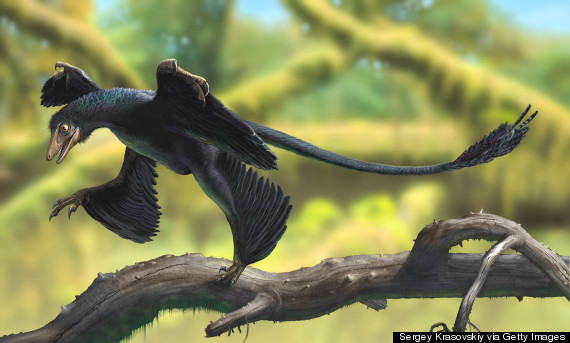
“Based on the findings so far, we assume that the dinosaur is something close to a microraptor or others in the raptor genera,” Lim Jong-deock, chief curator of the National Research Institute of Cultural Heritage, told the news agency. “However, it’s uncertain at this stage exactly which type of dinosaur it was, and there is a chance that it is a new type that hasn’t been reported to academia as of yet.”

The tiny dino is a theropod, a family of carnivorous dinosaurs that includes Tyrannosaurus rex. That means it had sharp teeth and claws--only a whole lot smaller. And if it is indeed a microraptor, it would also have had four wings.

The dinosaur lived during the Cretaceous period, which ended some 66 million years ago with the Cretaceous-Tertiary mass extinction event.

The way this dinosaur has been fossilized is unique in that it was discovered with its vertebrae connected to its ribs,” the institute told the Korea Times.

The institute also said there may be another fossilized dinosaur in the rock next to this one. Whatever the dinosaur turns out to be, it's the first complete dinosaur skeleton found in South Korea, and among the smallest dinosaur fossils ever found in the country.

"It is difficult for a small dinosaur to become fossilized and such fossils are very rare across the world," an unnamed researcher from the National Research Institute of Cultural Heritage told Korea.net. "We need to conduct further research into whether the fossil is related to the Minisauripus, whose footprints were discovered in the southern areas of Gyeongsangnam-do."


Read more here

Friday, November 28, 2014

Paleontologists Determine Dinosaurs Were Killed By Someone They Trusted

BERKELEY, CA—Citing compelling fossil evidence that the prehistoric species died suddenly and treacherously, paleontologists at the University of California, Berkeley announced Monday that dinosaurs were almost certainly killed by someone they trusted. “Our findings indicate that someone, we don’t know who, spent at least 150 million years gaining the confidence of dinosaurs before abruptly betraying them and taking their lives near the end of the Cretaceous Era,” said lead researcher Professor Janet Bower, adding that dinosaurs likely had an innately innocent and unsuspecting nature that this individual could exploit to get within easy striking distance. “The distribution and condition of dinosaur bones strongly suggests that these creatures died without a struggle and that they had been caught totally off-guard by an individual they naively considered a friend. Those that had time to regard their killer were no doubt absolutely shocked.” Bower went on to suggest that if the mightiest creatures to walk the face of the earth could be wiped out by letting someone get close to them, humanity could too.
Full article here

Thursday, November 6, 2014

Fossil From Dinosaur Era Reveals Big Mammal With Super Senses


Dinosaurs that roamed Madagascar more than 66 million years ago had a most unusual fuzzy mammal living in their shadows—one so large, and with such strange features, that scientists say they could have never predicted its existence.
 
That is, until 2010, when a team of scientists looking for fish fossils accidentally collected its nearly complete skull from a site along Madagascar's west coast.

Since then, researchers have learned that the groundhog-like critter had supersensory capabilities, with a large portion of its brain devoted to smell, and that it weighed about 20 pounds (9 kilograms)—much more than most mammals alive during the age of the dinosaurs.

"Not only does it have bizarre features, it's bizarre in being so humongous," says vertebrate paleontologist David Krause of Stony Brook University, in New York, who reports the find Wednesday in the journal Nature. Krause compares the critter's appearance to nutria, which are semiaquatic rodents, or an overgrown groundhog. "It's Punxsutawney Phil on steroids," he jokes.

What's more, the lucky find is helping paleontologists fill in the mammalian evolutionary tree, especially during the age of the dinosaurs.
Link to full article

Wednesday, October 29, 2014

‘Zaraapelta’ looked like a colourful hedgehog


An old dinosaur has been given a new name.
A new species of ankylosaur (ANK’-EYE’-lo-saur) was discovered in Mongolia in 2000 by a team led by University of Alberta researchers.
A zoological journal published a paper this week by the same group naming the creature Zaraapelta (zar-ah-PELL’-tah) nomadis.
Zaraapelta is a combination of Mongolian and Greek works meaning “hedgehog” and “shield.”
Like other ankylosaurs, Zaraapelta was an armoured plant-eater with a gigantic club for a tail.
But it was more spectacular than most, with distinctive horns and an elaborate pattern of bumps and grooves behind its eyes.
Its skull is part of a collection at the Mongolian Paleontologist Center.
Link

Sunday, October 26, 2014

Ancient Stone-Cutting Techniques Preserve Dinosaur Tracks


Unearthing the fossilized bones of dinosaurs without destroying them is already a pretty fiddly process, one that requires time, patience, and many, many delicate brushes. But when you're talking not about bones but the even more delicate tracks that dinosaurs left behind, the process gets that much trickier.
In response to reading about some ancient marble-cutting techniques, commenter and ichnologist Phaton explained that there were some remarkable similarities between the techniques of old stone-cutters and modern methods of dino-track salvage:
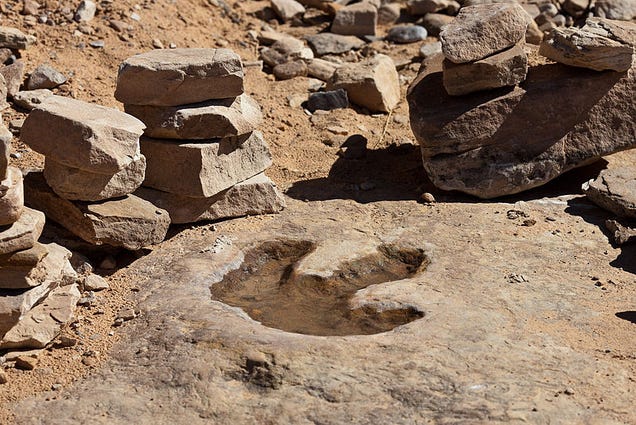
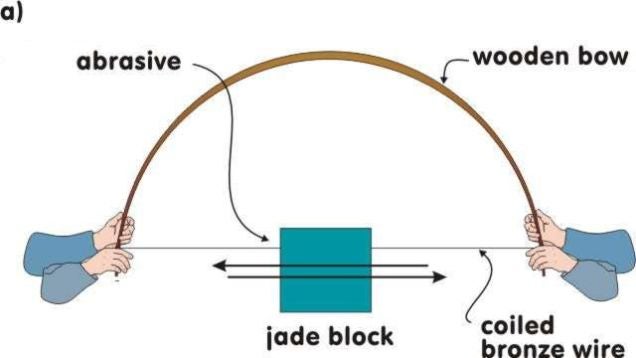
I had to figure out a way to remove a bunch of rock from a specimen with out damaging the fossil footprint. We were in the process of moving to a new building with a weight restriction on the floor and the block was going to probably be too heavy. The footprint, while large (tyranosaurid), was quite fragile so power tools were out of the question. In trying to figure something out I looked into a lot of ancient techniques. What I ended up using was a modification on a Chinese bow saw but instead of coiling bronze wire between the bow I coiled it around an iron shaft so that it was a one man operation... I don't remember why but I think I called it a Phoenician saw for some reason (a google search turns up nothing useful).

Anyways to make a long story shortish: the key to ancient rock cutting it time. As long as you have an abrasive harder then what you are cutting you are going to succeed eventually. Though I didn't actually succeed myself because before I could really start cutting we found really small turtle tracks associated with the theropod track and ended up needing to keep the whole block(it was one of those things where the theropod track was so imposing that you just didn't notice the smaller prints... but once you saw one...).

Article link here

Friday, October 24, 2014

Man who stole 190-million-year-old dinosaur footprint gets house arrest

"I'm just extremely sorry for a horrible decision that I made."

A Utah man was sentenced to a year probation, half of which must be served under house arrest, and fined $15,000 Monday after pleading guilty to stealing a fossilized dinosaur footprint believed to be 190 million years old.
The defendant, Jared Ehlers, 35, said he was "sorry" for unhinging the 150-pound sandstone slab in the Sand Flats Recreation Area of Southeastern Utah and dumping the three-toed print into the Colorado River. "I don't have a lot to say," Ehlers said during sentencing before US District Judge Dale Kimball. "I'm just extremely sorry for a horrible decision that I made."
While on the Hell's Revenge trail, Ehlers saw that the footprint was loose. He pried it up and took it to his nearby Moab home. Federal authorities said he dumped the print after being questioned about the print. He pleaded guilty in July to a felony count of theft of a paleontological resource.

Link to full article

Wednesday, October 22, 2014

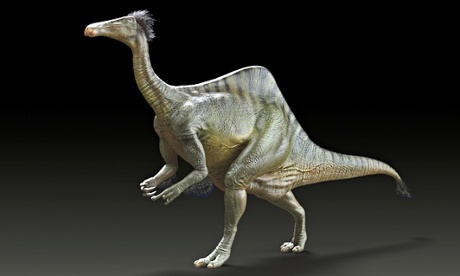
Bizarre dinosaur reconstructed after 50 years of wild speculation

Deinocheirus mirificus, or ‘unusual horrible hand’, had long, clawed forearms, a sail on its back and a duck-like bill
Nearly 50 years after researchers uncovered the gigantic arms of a mysterious dinosaur in the Gobi desert, the true nature of the beast has finally been established.
Since its discovery in 1965, the only clues to the engimatic creature were its shoulders and forelimbs – the latter measuring an astounding 2.4 metres long – and a few ribs and vertebrae dug from the ground by a joint Polish-Mongolian expedition.
The fossils were extraordinary enough for scientists to declare the dinosaur a new genus and species. The name they decided upon was Deinocheirus mirificus, meaning “unusual horrible hand”.
In the absence of more complete remains, early reconstructions were at times wildly speculative. In 1970, one palaeontologist argued that Deinocheirus was a giant sloth-like climber that hung beneath the branches of enormous trees. A more accurate view put the dinosaur in a group of beaked omnivores called ornithomimosaurs, which resembled giant ostriches, at least superficially.
But writing in the journal Nature on Wednesday , a Korean-led team of experts has transformed scientists’ understanding of the animal. They report the discovery of two nearly complete 70 million-year-old Deinocheirus skeletons, pieced together from fossils unearthed in Mongolia, along with a skull and hand that had been poached and sold on to private collectors.
With the new remains, the researchers built the first accurate reconstruction of the dinosaur. The creature stood tall on its back legs, but sported long, clawed forearms. Neural spines formed an impressive sail on its back and its long, toothless snout flared out to both sides. The duck-like bill may have helped Deinocheirus forage for food at the bottom of streams, while blunt, flattened bones under its claws prevented it from sinking on wet ground.
One of the new specimens grew to 11 metres long and weighed more than six tonnes. Its broad hips and large feet suggest it was not agile. The animal likely fed on plants and small animals, though the remains of fish were found among its stomach contents.
Read more here

Saturday, October 18, 2014

Two dinosaur toes lead to fossil find in Badlands

Meat-eating biped unearthed on hillside died 75 million years ago


When Clive Coy saw two small fossilized dinosaur toes sticking out the side of a hill in the Badlands, he hoped the remains of an entire animal were waiting to be unearthed.
The fossil of the small, meat-eating biped that Coy and other University of Alberta paleontologists excavated last month appears to be a saurornitholestes, but Coy and lead paleontologist Philip Currie said they haven't studied it enough to provide any details yet.
Back at the U of A, Coy is meticulously cleaning away the ancient mud and sand that have encased the little raptor for 75 million years. He couldn't yet say if it was indeed a complete skeleton.
"Something I've always enjoyed when I'm doing the preparation work is knowing I'm the first human being to see this," said Coy, who is the senior technician in the university's Vertebrate Paleontology Department.
The only mammals in existence in the late Cretaceous era, when Coy's dinosaur was alive, were mouse and opossum-sized creatures, and they were already nothing but fossils when humanity's earliest ancestors emerged.
"This animal is a fossil and now our (mammalian) ancestors are fossils ... Down the evolutionary chain, there's me digging up this creature that died 75 million years ago," Coy said.
Paleontologists Coy, Currie and Eva Koppelhus led last June's expedition with 15 other members of the international Explorers Club.
"We found a lot of good material, (including) half a dozen other skeletons that we need to investigate," Coy said. "This one was promising enough that we made a special trip out two weeks ago to dig down to see what this was."

Read the full article here