Most dinosaurs had scales, not feathers, fossil analysis concludes
Researchers have called time on a growing suspicion that many dinosaurs were not the dry, scaly animals of popular conception, but fluffy, feathered beasts instead.
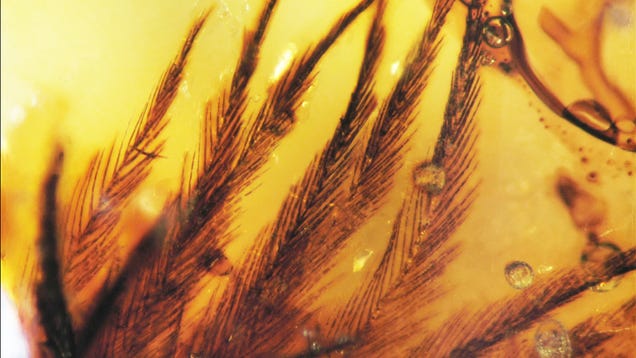
Remains unearthed in recent years have revealed feathers or proto-feathers on a range of dinosaurs, leading some paleontologists to wonder if all of the animals evolved from a feathered ancestor and sported some kind of plumage themselves.
But while many meat-eating theropods, such as velociraptors and relatives of tyrannosaurs, were clearly clad in feathers, a fresh analysis of prehistoric remains suggests that most dinosaurs were scaly beasts after all.
Nicolás Campione, a dinosaur researcher at Uppsala University in Sweden, worked with scientists at the Natural History Museum in London and the Royal Ontario Museum in Toronto to survey some of the best-preserved dinosaur fossils from museums around the world.
The scientists collected information on around 75 species that are known from the fossil remains of their soft tissues to have had either scales or feathers. From these, they created a dinosaur family tree and used a statistical model to work out the odds of species having feathers at different points in dinosaur history.
“What we found from this analysis is that the first dinosaur was probably not feathered,” said Campione. “Feathers clearly evolved in the dinosaur lineage, but right now, the data do not point to a feathered ancestor for them all.”
The first dinosaurs evolved from reptiles more than 230 million years ago. Feathers are thought to have arisen more than once in dinosaur lineages, and while they live on and give flight to modern birds, feathers first emerged for other reasons: for warmth or to provide colourful plumage displays.
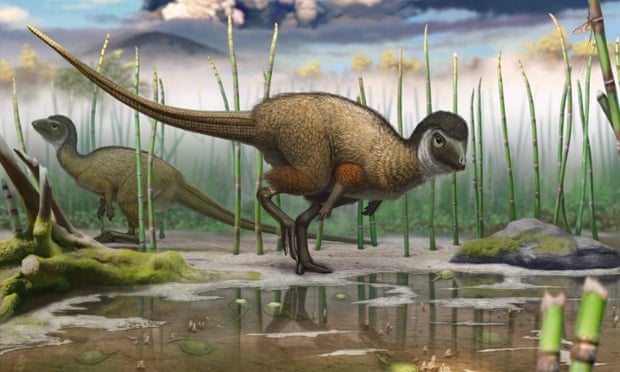
Last year, scientists announced the discovery in Siberia of Kulindadromeus, a small, 150 million-year-old, plant-eating dinosaur that had both scales and feathers. The finding of such an ancient plumage prompted the group to speculate that a fuzzy coating of feathers may have been the rule for dinosaurs rather than the exception. Some artists have run with the idea and drawn up depictions of giant feathered brontosaurs.
Remains unearthed in recent years have revealed feathers or proto-feathers on a range of dinosaurs, leading some paleontologists to wonder if all of the animals evolved from a feathered ancestor and sported some kind of plumage themselves.
But while many meat-eating theropods, such as velociraptors and relatives of tyrannosaurs, were clearly clad in feathers, a fresh analysis of prehistoric remains suggests that most dinosaurs were scaly beasts after all.
Nicolás Campione, a dinosaur researcher at Uppsala University in Sweden, worked with scientists at the Natural History Museum in London and the Royal Ontario Museum in Toronto to survey some of the best-preserved dinosaur fossils from museums around the world.
The scientists collected information on around 75 species that are known from the fossil remains of their soft tissues to have had either scales or feathers. From these, they created a dinosaur family tree and used a statistical model to work out the odds of species having feathers at different points in dinosaur history.
“What we found from this analysis is that the first dinosaur was probably not feathered,” said Campione. “Feathers clearly evolved in the dinosaur lineage, but right now, the data do not point to a feathered ancestor for them all.”
The first dinosaurs evolved from reptiles more than 230 million years ago. Feathers are thought to have arisen more than once in dinosaur lineages, and while they live on and give flight to modern birds, feathers first emerged for other reasons: for warmth or to provide colourful plumage displays.
Last year, scientists announced the discovery in Siberia of Kulindadromeus, a small, 150 million-year-old, plant-eating dinosaur that had both scales and feathers. The finding of such an ancient plumage prompted the group to speculate that a fuzzy coating of feathers may have been the rule for dinosaurs rather than the exception. Some artists have run with the idea and drawn up depictions of giant feathered brontosaurs.