Monday, June 26, 2017

Other Peoples' Kits & Instructions


From time to time, I build kits from other makers and share my feedback. It's a great experience, and every maker's kits are elevated by the experience of trading information about how they assemble.

We all approach instructions differently, and solve some of the making problems with differing talents. Instructions are often difficult to make and difficult to follow, so any advancement in this realm is a benefit to everyone. For instance, I include tiny instructions with Tinysaurs, naturally, so I put 3D instructions online in an effort to clarify some questions I was receiving about assembly.

Ronald Nelson of Induku Design makes amazing wood items. I got his Strandbeest and his Schrödinger's cat in a box. (My wife has asked me to put a spot of glue on the cat so that we can preserve the uncertainty.) His version of the Strandbeest is amazing and elegant. He has a great write-up of his development process and the original giant creation by Theo Jansen here.

The arrangement of gears creates a massive amount of torque from wind or finger power to overcome the imperfections of my assembly. I've attempted to make many all-wood mechanical laser cut things over the years, but have been unsuccessful without smooth machined parts. Ronald's Strandbeest kit has inspired me to keep trying.

Nice packaging. Feels like opening a gift.

Cut sheets, dowels, and a well-written instruction booklet that's easy to follow.

Separating pieces and sanding the sprues.

I put all the small parts into a tray. A pill diary or some small bowls would work too.

Ready to assemble!

Gear train complete. It's really cool to work the axels at this point.

Assembling the critter's legs.

Lots of spare parts in case you drop one under somewhere or break one.

 (H)air power! Strandbeest likes hair driers.

Friday, July 24, 2015

More than double in 24 hours. Thanks!

https://www.kickstarter.com/projects/1356792532/tiny-monsters-tiny-skeletons-you-assemble

Thanks for helping us make double our Kickstarter goal!

We've finished the Medusa prototype and have added the first stretch goal of $5,000. Your help has been wonderful. We still have 26 days to go in the campaign and several stretch goal ideas, so please keep sharing the project!

https://www.kickstarter.com/projects/1356792532/tiny-monsters-tiny-skeletons-you-assemble

Shorter limbs than T-rex

Four-legged snake fossil stuns scientists—and ignites controversy

Scientists have described what they say is the first known fossil of a four-legged snake. The limbs of the 120-or-so-million-year-old, 20-centimeter-long creature are remarkably well preserved and end with five slender digits that appear to have been functional. Thought to have come from Brazil, the fossil would be one of the earliest snakes found, suggesting that the group evolved from terrestrial precursors in Gondwana, the southern remnant of the supercontinent Pangaea. But although the creature’s overall body plan—and indeed, many of its individual anatomical features—is snakelike, some researchers aren’t so sure that it is a part of the snake family tree.

The team’s scientific interpretation may be the least controversial aspect of the discovery, which they report online today in Science. The specimen’s provenance seems to be murkier than the silty waters that once buried its carcass. Whereas the team’s analyses strongly suggest the fossil came from northeastern Brazil, details of when it was unearthed and how it eventually ended up in the German museum where it now resides remain a mystery. Those details matter to many researchers and especially to some from Brazil, because it’s been illegal to export fossils from that nation since 1942.

Aptly, the new species has been dubbed Tetrapodophis amplectus. The genus name, in Greek, means “four-footed serpent.” (Previously, fossils of creatures considered to be protosnakes have only sported one set of limbs, usually hindlimbs.) The species name amplectus, which comes from Latin, means “embracing” and refers to the creature’s flexibility and presumed ability to wrap tightly around its prey. The front part of the fossil—which appears to be complete and has all bones in their original, lifelike arrangement—lies in a tight coil, a demonstration of the animal’s extreme limberness, says Nicholas Longrich, a vertebrate paleontologist at the University of Bath in the United Kingdom and co-author of the new study. Besides the tiny limbs, the specimen sports a skull the size of a human fingernail, 160 spinal vertebrae, and 112 vertebrae in the tail.

The fossil had resided in a private collection for several decades before it gained the attention of team member David Martill of the University of Portsmouth. He stumbled across the specimen during a field trip with students to Museum Solnhofen in Germany. No notes about when or where it was collected are available, the researchers say. But certain characteristics of the limestone that entombed the fossil, as well as the distinct orange-brown color of the bones themselves, strongly suggest it came from a particular area of northeastern Brazil, Longrich says. The sediment that became those rocks accumulated in calm waters on the floor of a lake or a lagoon sometime between 113 million and 126 million years ago, he notes.

Regarding the legality of the fossil’s collection or export from its presumed home country, Martill says “Who knows how the fossil came from Brazil”? Furthermore, he notes, to assert that the fossil was collected illegally a person would need to ascertain when it was unearthed. But such questions are irrelevant to the fossil’s scientific significance, Martill maintains. “Personally I don’t care a damn how the fossil came from Brazil or when,” he says.

Many features of Tetrapodophis point to its snakiness. Among squamates, the group of reptiles that also includes lizards, only snakes have more than 150 spinal vertebrae, the researchers note. The creature’s teeth are pointy and slightly curved. Also, the fossil includes some scales that stretch across the full width of the belly, a trait known only in snakes. The dramatically reduced size of the creature’s limbs, as well as a cylindrical rather than a flattened tail, suggest that snakes evolved from terrestrial animals that burrowed, not from marine creatures as some researchers have proposed, Longrich says.

Read more here

Tuesday, July 21, 2015

Wednesday, June 24, 2015

Putting Flesh on Bone

More dinosaur bones yield traces of blood, soft tissue


Scientists studying dinosaur evolution are finding many more bones to pick.
Researchers from London have found hints of blood and fibrous tissue in a hodgepodge of 75-million-year-old dinosaur bones. These fossils had been poorly preserved. That now suggests residues of soft tissues may be more common in dino bones than scientists had thought. Details appeared June 9 in Nature Communications.

Scientists are excited at the idea that soft tissues might still exist in most dinosaur bones. It would give them the ability to study these long-extinct animals at the cellular level. And such studies could reveal when dinosaurs switched from being cold-blooded to warm-blooded creatures.

Matthew Collins is an expert in the study of ancient proteins at the University of York in England. (Proteins form the basis of living cells, muscle and tissues. They also do the work inside of cells.) Until now, scientists had thought that traces of soft tissue from dinosaurs remained only in really well-preserved fossils. “It’s exciting to think that we may have more soft tissue in dinosaur bones kicking around,” says Collins, who was not involved in the new study.

Susannah Maidment is a paleontologist at Imperial College London in England. She was part of a team that has just found residues of soft tissue in slivers of eight dinosaur bones. These included a toe claw from a theropod. There also was a rib from a duckbilled dinosaur. All had been found about a century ago, mostly in Alberta, Canada. Since then, the bones had been stashed in drawers at the Natural History Museum in London.

The team used a scanning electron microscope to study the bones. This special microscope can highlight features that are just a few billionths of a meter across. The dinosaur bone images revealed what appeared to be red blood cells. A second type of powerful microscope probed the structure of some bone features. These images showed bands similar to patterns formed by collagen in animal bones today. Collagen is a fibrous protein. It is found not only in bones, but also in cartilage, tendons and other connective tissues.


More on this story here

Tuesday, June 23, 2015

Embryos Hatched After 200 Million Years

Dinosaur Eggs Ready To Hatch Secrets 200 Million Years Later


In the late winter of 1976, the world famous fossil collector James Kitching was doing a survey near South Africa’s border with Lesotho.

To his surprise he found a tiny clutch of six fossilized eggs along the side of the road at a place known as Rooidraai.
It took five years for skilled palentologists to remove enough rock matrix from the eggs so that they could be preliminarily identified as the first dinosaur embryos from South Africa and the oldest dinosaur embryos in the world.

Research on dinosaurs has truly blossomed in the 40 years since Kitching’s extraordinary find and a great deal more is now known about the baby dinosaurs in the eggs. But the exceptional secrets they hold are only now being fully uncovered because of developments in technology. This month the eggs were flown to Grenoble, a city at the foot of the French Alps, where they are being examined under a powerful CT scan at the European Synchrotron Radiation Facility.
The secrets of the embryonic dinosaurs whose parents roamed South Africa 200 million years ago are in the process of being hatched.

These high-resolution, 3D x-ray imaging methods are burgeoning in palaeontology. With advances in modern imaging methods we are now able to digitally remove rock matrix while making 3D models of the bones inside.

CT scans come to the rescue

The solution to all of these problems lies in CT scanning the specimen. The x-ray resolution needed to study the embryos is so high (six microns, or .006 mm) that only a few facilities in the world are capable of performing the study.

In late 2014, a team of us put together a winning proposal to scan the eggs at the European Synchrotron Radiation Facility in Grenoble. At the facility, a huge ring of electrons (almost a kilometre in circumference) traveling at .99% of the speed of light continuously generates beams of high-energy X-rays. These beams can be harnessed with great precision to peer through rocks and image the fossils inside.
Full story here

Wednesday, June 17, 2015

Thursday, June 11, 2015

Woolly Camel?

Miners in north-western Canada have discovered ice age camel bones whose DNA is forcing scientists to redraw the family tree of the now-extinct species.

Grant Zazula, a paleontologist with the Yukon’s department of tourism and culture, said three fossils recovered from a gold mine in the Klondike in 2008 are the first western camel bones found in the territory or Alaska in decades.

Scientists had believed western camels that once lived in North America were related to llamas and alpacas common to South America, but they now have genetic proof that the animals are more closely tied to the camels inhabiting Asia and Arabia.

“For us, the gold is the fossils because it’s this incredible resource for understanding extinct and ancient animals of the ice age,” Zazula said.

Zazula said scientists can now begin to understand why the camels went extinct 13,000 years ago, at the end of the ice age.

Link to article

Thursday, June 4, 2015

Meet Hellboy

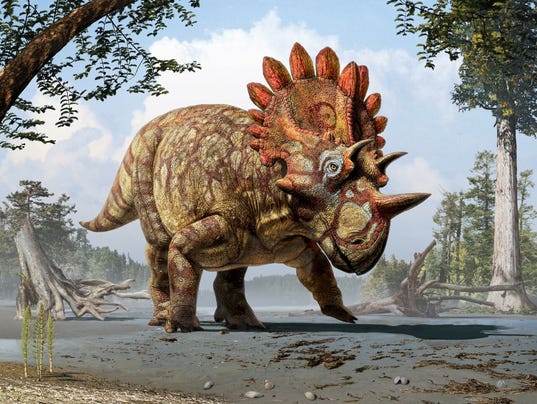
Behold the latest dinosaur discovery: Hellboy!

The latest new dinosaur – a beast with a corona of bone atop its enormous face – has an august scientific title based on Greek and Latin roots. But researchers call it something else: Hellboy.

The animal earned its impolite nickname thanks to the "devilishly hard" labor of extracting its skull from a bed of ultra-hard rock just above a river, says Darren Tanke of Canada's Royal Tyrrell Museum of Paleontology, who worked on the excavation and coined the dinosaur's moniker.

Stubs resembling devil's horns above the dinosaur's eyes also helped inspire the nickname, which the animal shares with a two-horned comic-book superhero.

No run-of-the-mill devil, the Hellboy dinosaur was more of a demon king. Besides its satanic horns, it boasted a crown-like ring of bony plates across its forehead, inspiring the first part of its scientific name, Regaliceratops, which means "royal horned-face."

Hellboy came to light thanks to amateur fossil hunter Peter Hews, who in 2005 saw a patch of dark stone on a riverbank in Alberta. Someone else would've passed it by. Hews, a consultant geologist, thought it might be bone and sent Tanke a photo. It was a good call. The second part of Hellboy's scientific name is peterhewsi, after the man who spotted it.

"I've done the easy part. I just found it," Hews says modestly.

Whether finding it was easy or not, the next part was a lot harder. Researchers needed an electric jackhammer to chisel the fossil out its resting place and a helicopter to lift the 1,300-pound stone block to a truck.

Full Article

Wednesday, June 3, 2015

This aught to ruffle a few feathers


Most dinosaurs had scales, not feathers, fossil analysis concludes 

Researchers have called time on a growing suspicion that many dinosaurs were not the dry, scaly animals of popular conception, but fluffy, feathered beasts instead.

Remains unearthed in recent years have revealed feathers or proto-feathers on a range of dinosaurs, leading some paleontologists to wonder if all of the animals evolved from a feathered ancestor and sported some kind of plumage themselves.

But while many meat-eating theropods, such as velociraptors and relatives of tyrannosaurs, were clearly clad in feathers, a fresh analysis of prehistoric remains suggests that most dinosaurs were scaly beasts after all.

Nicolás Campione, a dinosaur researcher at Uppsala University in Sweden, worked with scientists at the Natural History Museum in London and the Royal Ontario Museum in Toronto to survey some of the best-preserved dinosaur fossils from museums around the world.

The scientists collected information on around 75 species that are known from the fossil remains of their soft tissues to have had either scales or feathers. From these, they created a dinosaur family tree and used a statistical model to work out the odds of species having feathers at different points in dinosaur history.

“What we found from this analysis is that the first dinosaur was probably not feathered,” said Campione. “Feathers clearly evolved in the dinosaur lineage, but right now, the data do not point to a feathered ancestor for them all.”

The first dinosaurs evolved from reptiles more than 230 million years ago. Feathers are thought to have arisen more than once in dinosaur lineages, and while they live on and give flight to modern birds, feathers first emerged for other reasons: for warmth or to provide colourful plumage displays.

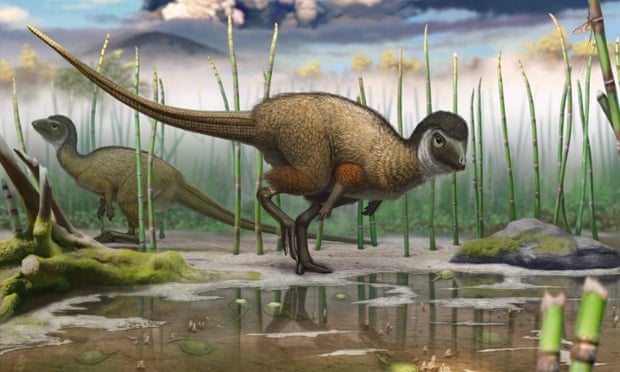
Last year, scientists announced the discovery in Siberia of Kulindadromeus, a small, 150 million-year-old, plant-eating dinosaur that had both scales and feathers. The finding of such an ancient plumage prompted the group to speculate that a fuzzy coating of feathers may have been the rule for dinosaurs rather than the exception. Some artists have run with the idea and drawn up depictions of giant feathered brontosaurs.

Saturday, May 23, 2015

Shedding pet dinosaurs

Q. Did dinosaurs peel or shed their skins?

A. Presumably, said Mark A. Norell, chairman of the division of paleontology at the American Museum of Natural History. But not all at once.

“Since we can’t directly observe extinct animals, we need to look at close relatives,” Dr. Norell said. “Birds are living dinosaurs, crocodilians their closest relatives. Both shed skin in patches and strips, not entire skins like snakes.

“Because crocodiles and birds share a common ancestor, we predict this skin-shedding style was present in that ancestor,” he continued. “Nonbird dinosaurs descend from this same ancestor. Without other information, we predict that even giant dinosaurs exfoliated their dead dry skin in patches.”

Everything that has skin sheds it, Dr. Norell emphasized, but there is a tremendous diversity in how skin sheds. In humans, for example, rubbing the dry skin of an arm across something black leaves a white scuff of dead skin cells, he said. And in birds, skin dries and sloughs off as small patches, like peeling after a bad sunburn.

Reptile shedding usually conjures visions of whole snakeskins, shed as a continuous piece, “looking like the ghost of a living serpent,” Dr. Norell said. But this is an anomaly; most animals do it differently. Typical reptiles — lizards, crocodiles and turtles — shed dry, irregular skin patches, and that is probably how dinosaurs did it, he said.

Link to NYTimes Question

Friday, May 22, 2015

Field Station: Dinosaurs making way for a highschool

'Field Station: Dinosaurs' park in Secaucus opening for final season

Outdoor prehistoric theme park "Field Station: Dinosaurs" will open tomorrow for its final season in Secaucus.

Park hours are 10 a.m. to 6 p.m. at 1 Dinosaur Way, Secaucus. The land of which the park sits will become the site of a new high school.

Originally opened in 2012, Field Station: Dinosaur was named Best Local Theme Park by Time Out New York that same year.

The themed family attraction has several different areas where participants can take part in games and workshops to receive stamps on their "passport," which they receive when they enter the park.

Featuring more than thirty life size moving dinosaurs, the various areas of the park include the base camp, the fire pit, amphitheater, the quarry, the lookout, and the plateau.


Wednesday, May 13, 2015

FrankenChicken


How Bird Beaks Got Their Start As Dinosaur Snouts

Scientists say they have reversed a bit of bird evolution in the lab and re-created a dinosaurlike snout in developing chickens.

"In this work, we can clearly see a comeback of the characteristics which we see in some of the first birds," says Arhat Abzhanov, an evolutionary biologist at Harvard University.

The ancestors of birds are a group of dinosaurs that includes the famous velociraptor, Abzhanov says. This group of meat-eaters had long snouts, small brains and eyes, and lots of teeth. Somehow they transformed into birds, which have none of those things.

Bhart-Anjan Bhullar, another member of the research team at Yale University, says the goal is to understand exactly how birds became birds. "What's the deep history of birdiness?" wonders Bhullar. "How did the different parts of their body plan form?"

In particular, he and his colleagues are interested in birds' distinctive beak, which Bhullar calls "this insane sort of snout that they have."

To hunt for clues about the origin of the beak, the researchers have been studying various kinds of animal embryos, from birds like emus and chickens to nonbird reptiles like alligators, which are birds' closest living relatives.


Their work led them to two specific genes. These genes are active in the middle of the face-forming region of bird embryos, but not in the middle of that region in the embryos of other animals.
The team did an experiment to see what would happen if they blocked the effect of that localized gene activity in chicken embryos.

Bhullar says he remembers the night he put the altered, developing chicks under a microscope, and saw that they had unusual, broad snouts.

"That was a pretty remarkable moment," he recalls. "That's a moment that will stay with me, I think."

Link to full article

Tuesday, May 12, 2015

Kids Bring Box of Poop to American Museum of Natural History

Bed Bugs & Fossilized Dinosaur Poop Surface At AMNH's Identification Day

Once a year, kids with bubble-wrapped bones and sandwich bags full of nubby rocks crowd around precision-lit folding tables in the American Museum of Natural History's Theodore Roosevelt Memorial Hall.

"We put this day on the calendar," said Caitlin Trasande, whose sons Camilo, 6, and Ramiro, 5, had just learned that the rocks they collected at Lake Taghkanic last summer contain 450-million-year-old marine fossils. "We were waiting and waiting for this day to come." Camilo, especially, couldn't believe it. "This was a flat snail that lived!" he shrieked, jumping up and down. "A brachiopod is a filter-feeding animal that usually lives in shells! You can see the imprint of the snail itself!"

Nearby, Entomologist Lou Sorkin held a sealed pill bottle of living bed bugs up to the light. A tiny camera projected the bugs onto a flat-screen television behind him. Sorkin studies bed bug infestations within New York apartment buildings, and he'll proudly show you the raw, red patch of skin on back of his hand where he lets them feed. Yesterday, he helped a nervous New Yorker identify a picture of a biting bug from her apartment. It was a mite.

On Identification Day, museum-staff Anthropologists, Paleontologists, Zoologists, and Ornithologists invite New Yorkers to bring in puzzling shells, artifacts, rocks, and occasionally insects and feathers. Equipped with magnifying glasses and comparison specimens from the museum collection, they start by asking for context—where did this bone come from? Did you find it on Rockaway Beach, or did you buy it on eBay? Paleontologist Carl Mehling admits that, "More than fifty percent of the time it's pure imagination. Someone will come in and say, 'This looks like a dinosaur skull!' But it's just a rock. When I hear something fantastic like that, I'm already concocting my gentle letdown."

That was the case for Joey Rosado and his son Javier, who like to visit Coney Island the day after a big storm, to collect bones and rocks that get spit out onto the sand. Javier handed over two sharp bones that he hoped came from a dinosaur. But Mehling quickly identified them as "left-over barbecue," citing the clean-cut edges that could only come from a bone saw.

There are exceptions, though. A few years ago, a woman showed Mehling a skull that she had found on the beach in Virginia. "Immediately I could see that it was part of a walrus skull. I knew that it couldn't be modern, because walruses today are strictly arctic. The skull is probably tens of millions of years old." And yesterday, even Mehling was surprised when a shoebox full of fossilized dinosaur poop landed on his table. Bridget, who lives in Manhattan, found the poop on a construction site when she was traveling in Berkshire, England.

Poop is one of Mehling's specialities, and it's notoriously hard to identify. "It's really, really hard to know what kind of animal fossilized poop came from, because, unlike a body part, poop doesn't have to look a certain way," he explained. "And when a creature poops, it's not obligated to hang out and die right next to it."

Full story and lots more pictures here

Monday, April 27, 2015

Hundred year old eggs -- times a million.

Home of the Dinosaurs


Tuesday, April 21, 2015

Every inch of Loch Ness being indexed by Google

The search for the Loch Ness monster has moved online, thanks to Google

The legend of the Loch Ness monster has captured people's imaginations for more than 1,000 years and shows no signs of waning.

There are more Google searches for the alleged creature today than there are for famous British institutions such as Buckingham Palace and the Peak District, the company revealed.

In response to the demand, Google is rewarding the cryptozoologists in all of us by making it possible to search for "Nessie" using Google Street View.

Google's announcement coincided with the 81st anniversary of the "Surgeons Photograph," an iconic image that appeared to show the ancient-looking reptile bobbing in the water, but was later revealed to be an elaborate hoax. Since then, many scientists have pointed out the sheer improbability -- if not impossibility -- of Nessie's existence. But that hasn't stopped the world from looking, and now Google is diving in.

With the help of Adrian Shine, who heads the Loch Ness and Morar Project, a team from Google mounted a 360-degree camera on a boat and captured images of the lake every 2.5 seconds, according to the Atlantic. The team also took underwater photos in the murky 800-foot lake, allowing monster hunters to scour above the water and below.

More here

Sunday, April 19, 2015

Some sap has a story to tell

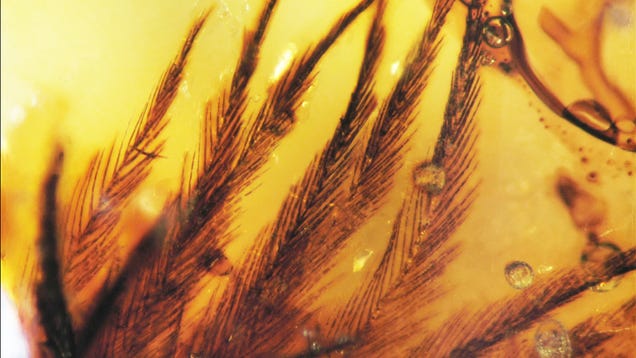
Dinosaur Feathers Discovered in Canadian Amber

Today a group of paleontologists announced the results of an extensive study of several well-preserved dinosaur feathers encased in amber. Their work, which included samples from many stages in the evolution of feathers, bolstered the findings of other scientists who've suggested that dinosaurs (winged and otherwise) had multicolored and transparent feathers of the sort you might see on birds today. The researchers also presented evidence, based on the feathers' pigmentation and structures, that today's bird feathers could have evolved from dinosaur feathers.
We've got a gallery of these intriguing feathers preserved in amber.
In a profile of lead researcher Ryan McKellar, The Atlantic's Hans Villarica writes:
These specimens represent distinct stages of feather evolution, from early-stage, single filament protofeathers to much more complex structures associated with modern diving birds... They can't determine which feathers belonged to birds or dinosaurs yet, but they did observe filament structures that are similar to those seen in other non-avian dinosaur fossils.
Villarica also did io9 readers a favor and asked McKellar whether this discovery could lead to a Jurassic Park scenario. McKellar said:
Put simply, no. The specimens that we examined are extremely small and would not be expected to contain any DNA material. To put this into context, the only genetic material that has been recovered from amber is from lumps of mummified insect muscle tissue in much younger Dominican amber that are approximately 17 million years old and well after the age of dinosaurs.
So much for our dreams of dino domination.

See more beautiful amber with feathers here

Thursday, April 9, 2015

5 Year Old Paleontologist Digs Dinos, Literally

This 5-year-old who found a rare dinosaur fossil in Texas is living his best life

On Wednesday, I realized I was not a cool 5-year-old. I suppose I always knew this.

Sure, I did cool things. I mean, I climbed trees and jumped in puddles and was generally pretty into Cardinals baseball and also sno cones. And that all sounds well and good.

But then I read this story about 5-year-old Wylie Brys, who — with his dad — discovered a dinosaur fossil, which is being excavated this month in Mansfield, Tex.

And now I'm forced to admit that my 5-year-old self was definitely not that rad. Not even close. Wylie Brys is straight crushing childhood.

Wylie goes poking around for fossils fairly regularly with his father, Tim Brys, who works at the Dallas Zoo. This particular find happened on land behind a suburban shopping center, not far from a grocery store.

On this trip, Wylie walked up ahead of his dad, Tim Brys told The Post in a telephone interview. When he came back, Wylie had a chunk of bone with him. Tim Brys asked his son to show him where he found it.

"My dad told me it was a turtle," Wylie told the Dallas Morning News. "But now he's telling me it's a dinosaur."

Said his father of the find: "It was a pretty good size and I knew I had something interesting."
Southern Methodist University scientists believe the fossil may be about 100 million years old.

Read more story here