Showing posts with label Triceratops. Show all posts

Thursday, June 4, 2015

Meet Hellboy

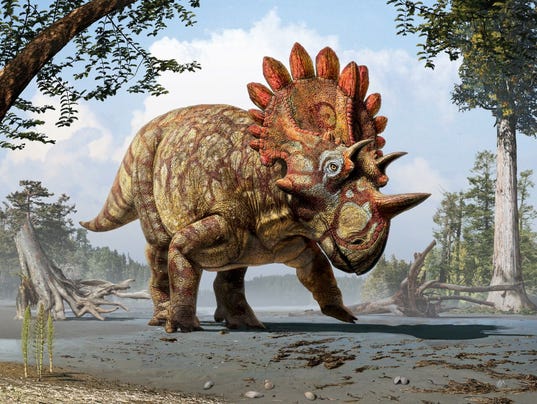
Behold the latest dinosaur discovery: Hellboy!

The latest new dinosaur – a beast with a corona of bone atop its enormous face – has an august scientific title based on Greek and Latin roots. But researchers call it something else: Hellboy.

The animal earned its impolite nickname thanks to the "devilishly hard" labor of extracting its skull from a bed of ultra-hard rock just above a river, says Darren Tanke of Canada's Royal Tyrrell Museum of Paleontology, who worked on the excavation and coined the dinosaur's moniker.

Stubs resembling devil's horns above the dinosaur's eyes also helped inspire the nickname, which the animal shares with a two-horned comic-book superhero.

No run-of-the-mill devil, the Hellboy dinosaur was more of a demon king. Besides its satanic horns, it boasted a crown-like ring of bony plates across its forehead, inspiring the first part of its scientific name, Regaliceratops, which means "royal horned-face."

Hellboy came to light thanks to amateur fossil hunter Peter Hews, who in 2005 saw a patch of dark stone on a riverbank in Alberta. Someone else would've passed it by. Hews, a consultant geologist, thought it might be bone and sent Tanke a photo. It was a good call. The second part of Hellboy's scientific name is peterhewsi, after the man who spotted it.

"I've done the easy part. I just found it," Hews says modestly.

Whether finding it was easy or not, the next part was a lot harder. Researchers needed an electric jackhammer to chisel the fossil out its resting place and a helicopter to lift the 1,300-pound stone block to a truck.

Full Article

Wednesday, November 26, 2014

Smithsonian's National Museum of Natural History Presents THE LAST AMERICAN DINOSAURS


Two enormous dinosaurs-Triceratops and Tyrannosaurus rex-reign over the National Museum of Natural History's new exhibition: "The Last American Dinosaurs: Discovering a Lost World." The 5,200-square-foot exhibition opens Nov. 25 on the second floor of the museum. It tells the story of non-avian dinosaurs' final years in western North America through an extraordinary diversity of animals and plants discovered in the fossil-rich layers of the Hell Creek Formation in North Dakota, South Dakota and Montana. The exhibition will remain on view until the completion of the museum's newly renovated dinosaur and fossil hall, scheduled for opening in 2019.

"This exhibition gives visitors a chance to explore the world in which dinosaurs lived between 66 and 68 million years ago, just before an enormous asteroid impact suddenly altered life on our planet forever," said Hans-Dieter Sues, curator of vertebrate paleontology and lead curator of the exhibition. "Examining long-gone ecosystems helps scientists understand how the world is changing today and what the consequences of a mass extinction could be in the future."

Set in North America's western interior, "Last American Dinosaurs" reveals what life was like for dinosaurs and other animals thriving during the Late Cretaceous Period. It features "Hatcher," a giant, plant-eating Triceratops, and the museum's nearly 14-foot-tall cast of a T. rex known as "Stan," two of the most imposing dinosaurs in the museum's collections. The skulls of an adultEdmontosaurus and an infant and yearling Triceratops also highlight the show, along with other fossil displays, murals of ancient environments, a video presentation showing behind-the-scene collaborations between scientists and paleo-artists working on the exhibit and an arcade-style game, "How to Become a Fossil." The murals give visitors a window into the past and feature plants and animals from the lush, diverse Hell Creek ecosystem.


Full article here