Showing posts with label t-rex. Show all posts

Saturday, March 21, 2015

Dinosaur Kisses

Did Dinosaurs Have Lips?

Paleoartist Puts a Face on Ancient Bones


CHICAGO—After careful consideration, Tyler Keillor made a decision: T. rex had lips. In the debate over dinosaurs’ “oral margin,” one of the country’s top paleoartists has taken sides. Mr. Keillor’s job is to create “flesh models” of dinosaurs and other prehistoric animals based on fossil evidence—giving creatures that died millions of years ago a face, a story and sometimes lips.

Using traditional mediums like clay and resin, as well as CT scanning and 3-D printing, he is at the forefront of incorporating digital art and technology into paleontology.

Mr. Keillor works at the University of Chicago Fossil Lab under celebrity paleontologist Paul Sereno. His work, found in museum collections around the world, is often the public’s first look at a newly discovered species, as with the pebbly-faced predator Rugops primus, which was unveiled in 2004. “A plain fossil doesn’t look like a heck of a lot to the average person,” Mr. Keillor says.

Instead of studying science, he cut his teeth working in a dental laboratory, doing special-effects makeup and studying wig making at Chicago’s Lyric Opera. As a child, he “would try to make little puppets of the alien from ‘Alien,’ ” he says. He dropped out of college to work on low-budget horror movies, commercials and stage productions.

His skill set was well-suited to Dr. Sereno’s team. After another paleoartist struggled with the hair of a “7,000-year-old beautiful woman,” Dr. Sereno says, he turned her over to Mr. Keillor. “When you see it in the ground in the field, you need to have the mind and eye of an artist,” he says. “Paleontology is about envisioning things and bringing them back to life.”

On a recent Thursday, the soft-spoken Mr. Keillor, 42 years old, was painting orange silicone over pieces of a 95-million-year-old rib, the last of about 100 Spinosaurus bones he was reproducing for the University of Chicago before it repatriated the originals back to Morocco.


Read full article

Monday, March 16, 2015

New Tinysaurs coming soon!

Almost finished editing the Angel and the Minotaur Tinysaur models!


Also, a modern, more accurate T-Rex coming soon!


Tuesday, March 3, 2015

Dino burns like fossil fuel.

Clive Palmer's dinosaur Jeff destroyed by fire at Palmer Coolum Resort

Fire has destroyed a 10-metre model Tyrannosaurus rex, nicknamed Jeff, that was standing at Clive Palmer's resort on Queensland's Sunshine Coast.

Firefighters were called to the blaze at the Coolum resort about 1:30am to find Jeff already well alight.

Police had been investigating whether the fire was started deliberately, but Mr Palmer told the ABC he did not believe arson was involved in Jeff's demise.

"Apparently he's had an electrical fault and burnt down," he said.

"There was a storm through the morning and all I know is there was an electrical fault and he caught fire and that was the end of him."

Mr Palmer said he was still deciding whether to bring in a replacement once what remained of Jeff was dismantled.


"Jeff's brother is waiting in the dinosaur park to be liberated to take his place," the Federal MP said.
"Question is whether we bring him out or whether we leave him where he is - he's very happy with the other dinosaurs.

"Certainly the next birth we have of a dinosaur, we will name after Jeff."
Queensland Fire and Emergency Service Superintendant Russell Thompson said Jeff's rubber and fiberglass coating burnt "very, very quickly".

"Very unusual call this one - we had a dinosaur on fire. I've had everything else but this is the first time I've had a dinosaur on fire," he said.

"There was only a small section of the tail left that was unburnt once the first appliance arrived.
"They had that fire out within a few minutes."

Full article

Wednesday, December 3, 2014

Stolen Dinosaur Skull Can Go Back to Mongolia: U.S. Court


The remains of a 70-million-year-old dinosaur that was falsely labeled as a cheap replica and smuggled into New York earlier this year can be returned to its native Mongolia, the United States Attorney's Office said on Tuesday

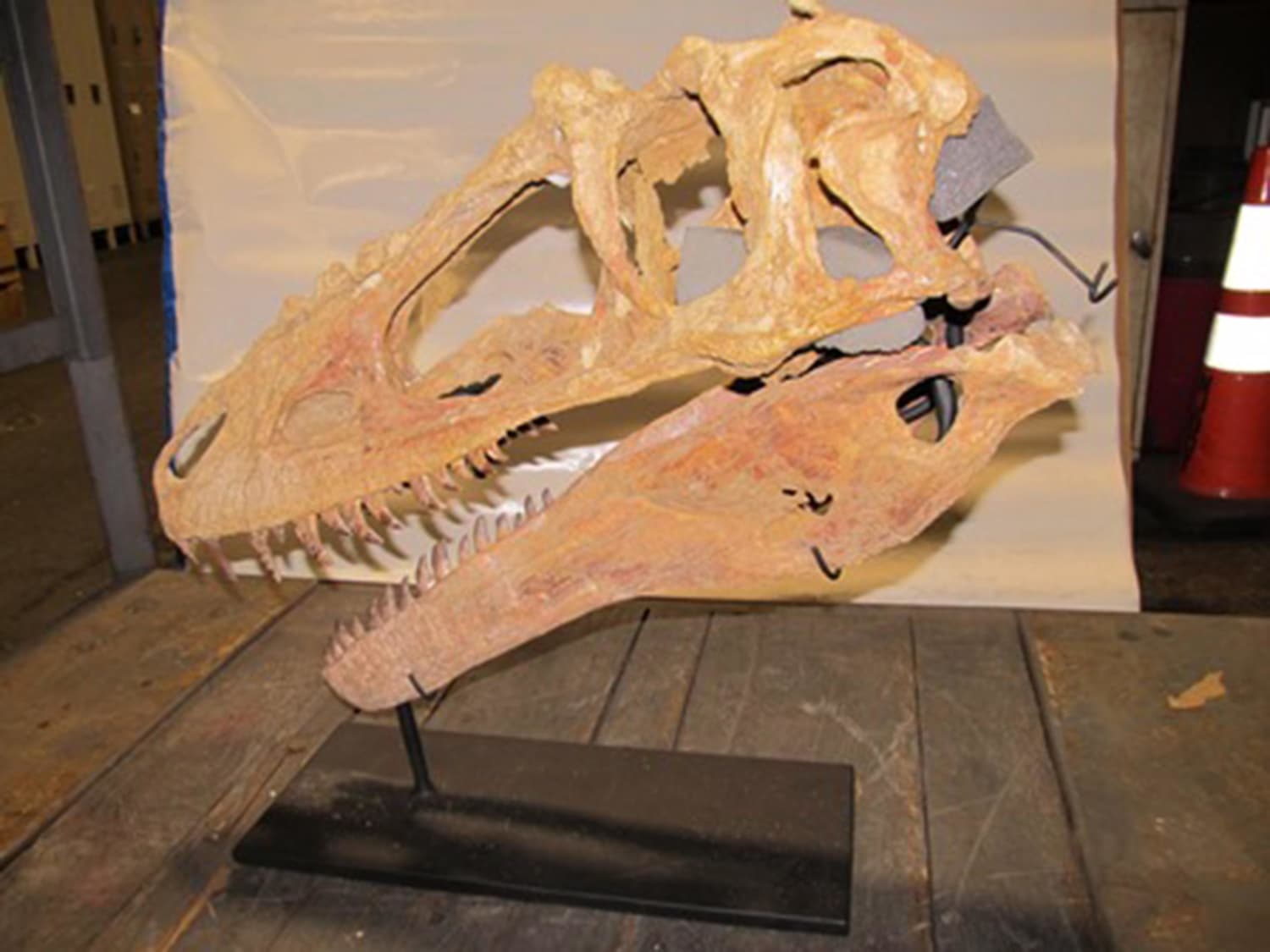
A federal court judge in the Eastern District of New York ruled that the skull and vertebrae of the Alioramus dinosaur, a relative of the Tyrannosaurus Rex, must be forfeited by the French fossil dealers who exported the remains. 

"We are determined to expose and halt the flow of stolen cultural property entering our ports," Loretta Lynch, United States Attorney for the Eastern District of New York, said in a statement.
In January, U.S. Customs and Border protection officials seized the dinosaur fossils, sent to New York from France by Geofossiles Inc, which claimed that the skull was a French-made replica, the statement said. 

In a petition for the items' release, Geofossiles later conceded that the fossils were genuine, originating from Mongolia, and provided forged documents claiming that the remains could legally be exported, the statement said. The company also attached a contract to sell the skull for $250,000.
Under Mongolian law, significant fossil discoveries cannot be permanently exported or sold to non-Mongolians, even if privately owned. 

Geofossiles could not immediately be reached for comment. 

Now that the skull and vertebrae have been forfeited, the Mongolian government, which assisted with the forfeiture case along with the Central Museum of Mongolian Dinosaurs, can submit a petition for the return of the fossils. 

Wednesday, November 26, 2014

Smithsonian's National Museum of Natural History Presents THE LAST AMERICAN DINOSAURS


Two enormous dinosaurs-Triceratops and Tyrannosaurus rex-reign over the National Museum of Natural History's new exhibition: "The Last American Dinosaurs: Discovering a Lost World." The 5,200-square-foot exhibition opens Nov. 25 on the second floor of the museum. It tells the story of non-avian dinosaurs' final years in western North America through an extraordinary diversity of animals and plants discovered in the fossil-rich layers of the Hell Creek Formation in North Dakota, South Dakota and Montana. The exhibition will remain on view until the completion of the museum's newly renovated dinosaur and fossil hall, scheduled for opening in 2019.

"This exhibition gives visitors a chance to explore the world in which dinosaurs lived between 66 and 68 million years ago, just before an enormous asteroid impact suddenly altered life on our planet forever," said Hans-Dieter Sues, curator of vertebrate paleontology and lead curator of the exhibition. "Examining long-gone ecosystems helps scientists understand how the world is changing today and what the consequences of a mass extinction could be in the future."

Set in North America's western interior, "Last American Dinosaurs" reveals what life was like for dinosaurs and other animals thriving during the Late Cretaceous Period. It features "Hatcher," a giant, plant-eating Triceratops, and the museum's nearly 14-foot-tall cast of a T. rex known as "Stan," two of the most imposing dinosaurs in the museum's collections. The skulls of an adultEdmontosaurus and an infant and yearling Triceratops also highlight the show, along with other fossil displays, murals of ancient environments, a video presentation showing behind-the-scene collaborations between scientists and paleo-artists working on the exhibit and an arcade-style game, "How to Become a Fossil." The murals give visitors a window into the past and feature plants and animals from the lush, diverse Hell Creek ecosystem.


Full article here

Sunday, November 16, 2014

Thursday, November 13, 2014

Paleontologist Jack Horner is hard at work trying to turn a chicken into a dinosaur


In 2009, the world’s most famous paleontologist made a bold claim. In “How to Build a Dinosaur,” Jack Horner proposed re-creating a small dinosaur by reactivating ancient DNA found in its descendants, chickens. His 2011 TED talk on the subject went viral. And then for the past four years, the public heard nothing.

While the Internet moved on to other viral videos and ideas, Horner and his team have been working on the “chickenosaurus” and moving ahead the science of evolutionary development. The project has already resulted in some of the first research into the embryonic development of tails.

The idea that birds are descended from dinosaurs is no longer questioned within the mainstream scientific community. Paleontologists have long studied the changes in bone structure of dinosaurs and birds over time. Meanwhile, molecular biologists have studied the composition of modern bird genes. By merging these scientists’ work, Horner, who is curator of paleontology at the Museum of the Rockies in Bozeman, Mont., hopes to answer questions about evolution.

Horner’s premise can be viewed from the launchpad of the late Michael Crichton’s novel and film “Jurassic Park,” a story that involved obtaining dinosaur DNA from undigested blood in mosquitoes preserved in amber. The idea of finding dinosaur DNA this way was taken seriously by many people, and the possibility was explored by scientists.

Jack Horner knows the “Jurassic Park” theory very well, having served not only as the inspiration for one of the main characters but also as a technical adviser for the film. But 24 years after the novel was published, we have yet to find any DNA in mosquitoes from the time of the dinosaurs.

DNA degrades under even ideal storage conditions. Cool, sterile conditions can extend its useful life to as long as perhaps a few million years, and dinosaurs disappeared about 65 million years ago. No matter how perfect a mosquito we find in a blob of amber, we cannot make a dinosaur out of that mosquito’s last blood meal.

There is only one way that DNA has been proved to survive millions of years relatively intact: by replicating itself during that time. This is exactly what happened as birds evolved from dinosaurs.