Thursday, June 4, 2015

Meet Hellboy

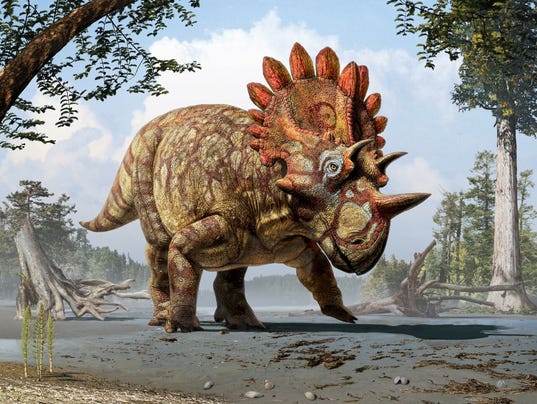
Behold the latest dinosaur discovery: Hellboy!

The latest new dinosaur – a beast with a corona of bone atop its enormous face – has an august scientific title based on Greek and Latin roots. But researchers call it something else: Hellboy.

The animal earned its impolite nickname thanks to the "devilishly hard" labor of extracting its skull from a bed of ultra-hard rock just above a river, says Darren Tanke of Canada's Royal Tyrrell Museum of Paleontology, who worked on the excavation and coined the dinosaur's moniker.

Stubs resembling devil's horns above the dinosaur's eyes also helped inspire the nickname, which the animal shares with a two-horned comic-book superhero.

No run-of-the-mill devil, the Hellboy dinosaur was more of a demon king. Besides its satanic horns, it boasted a crown-like ring of bony plates across its forehead, inspiring the first part of its scientific name, Regaliceratops, which means "royal horned-face."

Hellboy came to light thanks to amateur fossil hunter Peter Hews, who in 2005 saw a patch of dark stone on a riverbank in Alberta. Someone else would've passed it by. Hews, a consultant geologist, thought it might be bone and sent Tanke a photo. It was a good call. The second part of Hellboy's scientific name is peterhewsi, after the man who spotted it.

"I've done the easy part. I just found it," Hews says modestly.

Whether finding it was easy or not, the next part was a lot harder. Researchers needed an electric jackhammer to chisel the fossil out its resting place and a helicopter to lift the 1,300-pound stone block to a truck.

Full Article

Wednesday, June 3, 2015

This aught to ruffle a few feathers


Most dinosaurs had scales, not feathers, fossil analysis concludes 

Researchers have called time on a growing suspicion that many dinosaurs were not the dry, scaly animals of popular conception, but fluffy, feathered beasts instead.

Remains unearthed in recent years have revealed feathers or proto-feathers on a range of dinosaurs, leading some paleontologists to wonder if all of the animals evolved from a feathered ancestor and sported some kind of plumage themselves.

But while many meat-eating theropods, such as velociraptors and relatives of tyrannosaurs, were clearly clad in feathers, a fresh analysis of prehistoric remains suggests that most dinosaurs were scaly beasts after all.

Nicolás Campione, a dinosaur researcher at Uppsala University in Sweden, worked with scientists at the Natural History Museum in London and the Royal Ontario Museum in Toronto to survey some of the best-preserved dinosaur fossils from museums around the world.

The scientists collected information on around 75 species that are known from the fossil remains of their soft tissues to have had either scales or feathers. From these, they created a dinosaur family tree and used a statistical model to work out the odds of species having feathers at different points in dinosaur history.

“What we found from this analysis is that the first dinosaur was probably not feathered,” said Campione. “Feathers clearly evolved in the dinosaur lineage, but right now, the data do not point to a feathered ancestor for them all.”

The first dinosaurs evolved from reptiles more than 230 million years ago. Feathers are thought to have arisen more than once in dinosaur lineages, and while they live on and give flight to modern birds, feathers first emerged for other reasons: for warmth or to provide colourful plumage displays.

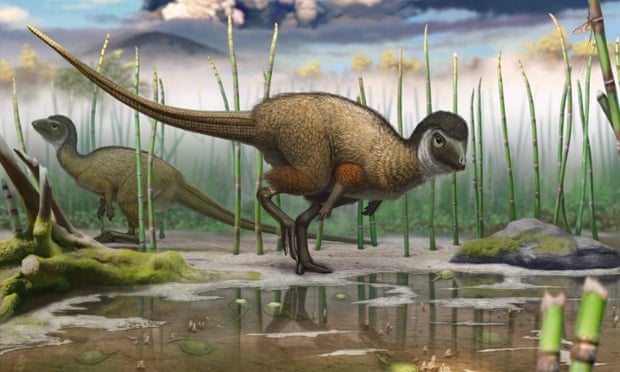
Last year, scientists announced the discovery in Siberia of Kulindadromeus, a small, 150 million-year-old, plant-eating dinosaur that had both scales and feathers. The finding of such an ancient plumage prompted the group to speculate that a fuzzy coating of feathers may have been the rule for dinosaurs rather than the exception. Some artists have run with the idea and drawn up depictions of giant feathered brontosaurs.

Saturday, May 23, 2015

Shedding pet dinosaurs

Q. Did dinosaurs peel or shed their skins?

A. Presumably, said Mark A. Norell, chairman of the division of paleontology at the American Museum of Natural History. But not all at once.

“Since we can’t directly observe extinct animals, we need to look at close relatives,” Dr. Norell said. “Birds are living dinosaurs, crocodilians their closest relatives. Both shed skin in patches and strips, not entire skins like snakes.

“Because crocodiles and birds share a common ancestor, we predict this skin-shedding style was present in that ancestor,” he continued. “Nonbird dinosaurs descend from this same ancestor. Without other information, we predict that even giant dinosaurs exfoliated their dead dry skin in patches.”

Everything that has skin sheds it, Dr. Norell emphasized, but there is a tremendous diversity in how skin sheds. In humans, for example, rubbing the dry skin of an arm across something black leaves a white scuff of dead skin cells, he said. And in birds, skin dries and sloughs off as small patches, like peeling after a bad sunburn.

Reptile shedding usually conjures visions of whole snakeskins, shed as a continuous piece, “looking like the ghost of a living serpent,” Dr. Norell said. But this is an anomaly; most animals do it differently. Typical reptiles — lizards, crocodiles and turtles — shed dry, irregular skin patches, and that is probably how dinosaurs did it, he said.

Link to NYTimes Question

Friday, May 22, 2015

Field Station: Dinosaurs making way for a highschool

'Field Station: Dinosaurs' park in Secaucus opening for final season

Outdoor prehistoric theme park "Field Station: Dinosaurs" will open tomorrow for its final season in Secaucus.

Park hours are 10 a.m. to 6 p.m. at 1 Dinosaur Way, Secaucus. The land of which the park sits will become the site of a new high school.

Originally opened in 2012, Field Station: Dinosaur was named Best Local Theme Park by Time Out New York that same year.

The themed family attraction has several different areas where participants can take part in games and workshops to receive stamps on their "passport," which they receive when they enter the park.

Featuring more than thirty life size moving dinosaurs, the various areas of the park include the base camp, the fire pit, amphitheater, the quarry, the lookout, and the plateau.


Wednesday, May 13, 2015

FrankenChicken


How Bird Beaks Got Their Start As Dinosaur Snouts

Scientists say they have reversed a bit of bird evolution in the lab and re-created a dinosaurlike snout in developing chickens.

"In this work, we can clearly see a comeback of the characteristics which we see in some of the first birds," says Arhat Abzhanov, an evolutionary biologist at Harvard University.

The ancestors of birds are a group of dinosaurs that includes the famous velociraptor, Abzhanov says. This group of meat-eaters had long snouts, small brains and eyes, and lots of teeth. Somehow they transformed into birds, which have none of those things.

Bhart-Anjan Bhullar, another member of the research team at Yale University, says the goal is to understand exactly how birds became birds. "What's the deep history of birdiness?" wonders Bhullar. "How did the different parts of their body plan form?"

In particular, he and his colleagues are interested in birds' distinctive beak, which Bhullar calls "this insane sort of snout that they have."

To hunt for clues about the origin of the beak, the researchers have been studying various kinds of animal embryos, from birds like emus and chickens to nonbird reptiles like alligators, which are birds' closest living relatives.


Their work led them to two specific genes. These genes are active in the middle of the face-forming region of bird embryos, but not in the middle of that region in the embryos of other animals.
The team did an experiment to see what would happen if they blocked the effect of that localized gene activity in chicken embryos.

Bhullar says he remembers the night he put the altered, developing chicks under a microscope, and saw that they had unusual, broad snouts.

"That was a pretty remarkable moment," he recalls. "That's a moment that will stay with me, I think."

Link to full article

Tuesday, May 12, 2015

Kids Bring Box of Poop to American Museum of Natural History

Bed Bugs & Fossilized Dinosaur Poop Surface At AMNH's Identification Day

Once a year, kids with bubble-wrapped bones and sandwich bags full of nubby rocks crowd around precision-lit folding tables in the American Museum of Natural History's Theodore Roosevelt Memorial Hall.

"We put this day on the calendar," said Caitlin Trasande, whose sons Camilo, 6, and Ramiro, 5, had just learned that the rocks they collected at Lake Taghkanic last summer contain 450-million-year-old marine fossils. "We were waiting and waiting for this day to come." Camilo, especially, couldn't believe it. "This was a flat snail that lived!" he shrieked, jumping up and down. "A brachiopod is a filter-feeding animal that usually lives in shells! You can see the imprint of the snail itself!"

Nearby, Entomologist Lou Sorkin held a sealed pill bottle of living bed bugs up to the light. A tiny camera projected the bugs onto a flat-screen television behind him. Sorkin studies bed bug infestations within New York apartment buildings, and he'll proudly show you the raw, red patch of skin on back of his hand where he lets them feed. Yesterday, he helped a nervous New Yorker identify a picture of a biting bug from her apartment. It was a mite.

On Identification Day, museum-staff Anthropologists, Paleontologists, Zoologists, and Ornithologists invite New Yorkers to bring in puzzling shells, artifacts, rocks, and occasionally insects and feathers. Equipped with magnifying glasses and comparison specimens from the museum collection, they start by asking for context—where did this bone come from? Did you find it on Rockaway Beach, or did you buy it on eBay? Paleontologist Carl Mehling admits that, "More than fifty percent of the time it's pure imagination. Someone will come in and say, 'This looks like a dinosaur skull!' But it's just a rock. When I hear something fantastic like that, I'm already concocting my gentle letdown."

That was the case for Joey Rosado and his son Javier, who like to visit Coney Island the day after a big storm, to collect bones and rocks that get spit out onto the sand. Javier handed over two sharp bones that he hoped came from a dinosaur. But Mehling quickly identified them as "left-over barbecue," citing the clean-cut edges that could only come from a bone saw.

There are exceptions, though. A few years ago, a woman showed Mehling a skull that she had found on the beach in Virginia. "Immediately I could see that it was part of a walrus skull. I knew that it couldn't be modern, because walruses today are strictly arctic. The skull is probably tens of millions of years old." And yesterday, even Mehling was surprised when a shoebox full of fossilized dinosaur poop landed on his table. Bridget, who lives in Manhattan, found the poop on a construction site when she was traveling in Berkshire, England.

Poop is one of Mehling's specialities, and it's notoriously hard to identify. "It's really, really hard to know what kind of animal fossilized poop came from, because, unlike a body part, poop doesn't have to look a certain way," he explained. "And when a creature poops, it's not obligated to hang out and die right next to it."

Full story and lots more pictures here