Showing posts with label news. Show all posts

Wednesday, December 3, 2014

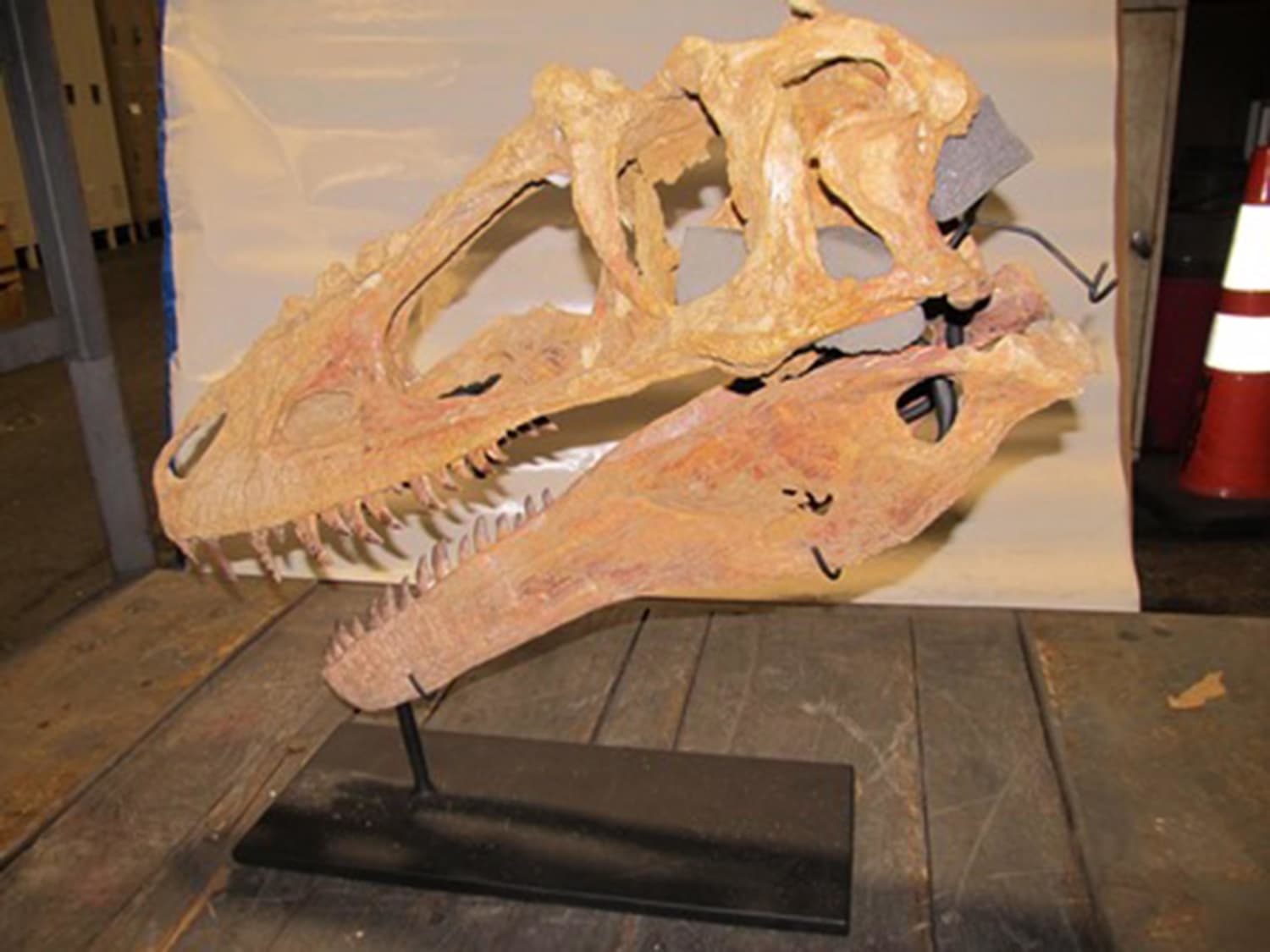
Stolen Dinosaur Skull Can Go Back to Mongolia: U.S. Court


The remains of a 70-million-year-old dinosaur that was falsely labeled as a cheap replica and smuggled into New York earlier this year can be returned to its native Mongolia, the United States Attorney's Office said on Tuesday

A federal court judge in the Eastern District of New York ruled that the skull and vertebrae of the Alioramus dinosaur, a relative of the Tyrannosaurus Rex, must be forfeited by the French fossil dealers who exported the remains. 

"We are determined to expose and halt the flow of stolen cultural property entering our ports," Loretta Lynch, United States Attorney for the Eastern District of New York, said in a statement.
In January, U.S. Customs and Border protection officials seized the dinosaur fossils, sent to New York from France by Geofossiles Inc, which claimed that the skull was a French-made replica, the statement said. 

In a petition for the items' release, Geofossiles later conceded that the fossils were genuine, originating from Mongolia, and provided forged documents claiming that the remains could legally be exported, the statement said. The company also attached a contract to sell the skull for $250,000.
Under Mongolian law, significant fossil discoveries cannot be permanently exported or sold to non-Mongolians, even if privately owned. 

Geofossiles could not immediately be reached for comment. 

Now that the skull and vertebrae have been forfeited, the Mongolian government, which assisted with the forfeiture case along with the Central Museum of Mongolian Dinosaurs, can submit a petition for the return of the fossils. 

Saturday, October 18, 2014

Two dinosaur toes lead to fossil find in Badlands

Meat-eating biped unearthed on hillside died 75 million years ago


When Clive Coy saw two small fossilized dinosaur toes sticking out the side of a hill in the Badlands, he hoped the remains of an entire animal were waiting to be unearthed.
The fossil of the small, meat-eating biped that Coy and other University of Alberta paleontologists excavated last month appears to be a saurornitholestes, but Coy and lead paleontologist Philip Currie said they haven't studied it enough to provide any details yet.
Back at the U of A, Coy is meticulously cleaning away the ancient mud and sand that have encased the little raptor for 75 million years. He couldn't yet say if it was indeed a complete skeleton.
"Something I've always enjoyed when I'm doing the preparation work is knowing I'm the first human being to see this," said Coy, who is the senior technician in the university's Vertebrate Paleontology Department.
The only mammals in existence in the late Cretaceous era, when Coy's dinosaur was alive, were mouse and opossum-sized creatures, and they were already nothing but fossils when humanity's earliest ancestors emerged.
"This animal is a fossil and now our (mammalian) ancestors are fossils ... Down the evolutionary chain, there's me digging up this creature that died 75 million years ago," Coy said.
Paleontologists Coy, Currie and Eva Koppelhus led last June's expedition with 15 other members of the international Explorers Club.
"We found a lot of good material, (including) half a dozen other skeletons that we need to investigate," Coy said. "This one was promising enough that we made a special trip out two weeks ago to dig down to see what this was."

Read the full article here

Sunday, October 5, 2014

Apatosaurus: Your Dinosaurs Are Wrong #12

Brontosaurus has been a popular request over the last few months. After a modest correction relating to naming conventions, Steve obliges! Using a rather jiggly example, he covers what made these creatures extremely successful for their time.

Saturday, October 4, 2014

Dinosaur Arms to Bird Wings: It's All in the Wrist

One of the last niggling doubts about the link between dinosaurs and birds may be settled by a new study that shows how bird wrists evolved from those of their dinosaur predecessors.
The study, reported in the Journal PLOS Biology, shows how nine dinosaurian wrist bones were reduced over millions of years of evolution to just four wrist bones in modern day birds.
"This discovery clarifies how dinosaur arms became bird wings," said one of the study's authors, Dr Alexander Vargas of the University of Chile in Santiago.
"It shows that some bones fused, other bones disappeared, and one bone disappeared and then reappeared in evolution."
Skeletal similarities between theropod dinosaurs and birds provide some of the strongest evidence showing how birds developed from dinosaurs. But the evolution of straight dinosaur wrists into hyperflexible wrists allowing birds to fold their wings when not flying, has remained a point of contention between palaeontologists and some developmental biologists.
Among the structures in question is a half-moon shaped wrist bone called the semilunate which is found in dinosaurs and looks very similar to a wrist bone also found in birds.
The semilunate originated as two separate dinosaur bones which eventually fused into a single bone. However some developmental biologists claim it evolved as a single bone in birds, and so isn't the same bone as that found in dinosaurs.
To help settle the debate, Vargas and colleagues examined the wrist bones of dinosaur fossils in the collections from several museums, and compared them to new developmental data from seven different species of modern birds.
"We developed a new technique called whole-mount immunostaining, which allows us to observe skeleton development better than ever before, including the expression of proteins inside embryonic cartilage," said Vargas.
Read more here

Thursday, October 2, 2014

Dinosaurs, Pterosaurs And Other Saurs -- Big Differences


What is a dinosaur? Here’s the definition from Dictionary.com:
Any chiefly terrestrial, herbivorous or carnivorous reptile of the extinct orders Saurischia and Ornithischia, from the Mesozoic Era, certain species of which are the largest known land animals.
That’s a decent description of a dinosaur, but it’s not the scientific definition.

Paleontologists don’t group species together according to when and where they lived, but based on shared characteristics, usually anatomical features seen in fossils. Dozens of features distinguish dinosaurs from other reptiles, such as bones of the lower arm being longer than the upper arm. When Paleontologists combine and compare such characteristics between various reptiles, they can create a tree of evolutionary history that reveals the relationships between different groups.

Several groups of prehistoric creatures are often mistaken for dinosaurs, even though evolutionary trees show that they’re distantly related. One group doesn’t even consist of reptiles. To help you tell extinct reptiles apart, here is a simple guide to the major features of dinosaurs and ‘other saurs’, arranged in order of when the animals appeared millions of years ago (MYA).

Link to guide

Wednesday, October 1, 2014

Scientists name new dinosaur after a creature from 'Avatar'

One of the perks of discovering a new species of dinosaur is that you get to name it whatever you want, even if it's a movie reference. Last week, a group of paleontologists from the Chinese Academy of Sciences put that rule to the test when they decided to name their latest find the "Ikrandraci avatar" — literally, "the Ikran dragon from Avatar."
In the movie, Ikrans were the blue dragon-looking creatures that the Na'vi rode into battle, and apparently the scientists saw a resemblance. Their new find is a pterosaur with a pelican-like throat pouch and a wingspan of roughly eight feet, but the scientists say the name was inspired by an Ikran-like crest on the creature's lower jaw. The group believes the new pterosaur fed largely on fish from freshwater lakes, and the crest was useful for scooping them out of the water. Still, the artist's rendering looks more like a pelican than anything else, suggesting the group may have let their fandom get the best of them.

Go to article